Resource · Coverage
MSP vs extended health: what actually covers therapy in BC
Counselling is not covered by MSP in BC: the province lists the services of counsellors and psychologists among the things MSP does not pay for. MSP covers medically necessary physician services, including your GP and, on referral, a psychiatrist. It does not cover private counselling with a counsellor, psychologist, or social worker. Free publicly funded mental-health care does exist through health authorities and community programs; private therapy is paid for out of pocket or through an extended health plan.
British Columbians are used to health care being covered. Mental health is the place where that assumption breaks.
5 min read · Updated
The two systems, side by side
| MSP (public) | Extended health (private insurance) | |
|---|---|---|
| Who pays | Province of BC | Your employer's plan, or a policy you buy |
| GP appointments | Covered | Not applicable |
| Psychiatrist (on referral) | Covered | Not applicable |
| Health authority mental-health services | Covered | Not applicable |
| Private counselling (RCC) | Not covered | Many plans, depending on the plan; check the wording |
| Private psychologist | Not covered | Many plans, depending on the plan |
| Medication | Not covered by MSP itself | Often covered; PharmaCare may also apply |
| Wait time | Varies by region and urgency | Usually days to a couple of weeks |
What MSP does cover for mental health
It is worth being precise, because "MSP doesn't cover therapy" leads some people to assume nothing is available publicly, which is not true.
Your GP is covered, and a GP appointment about mental health is a legitimate use of one. They can assess, discuss medication, sign you off work, and refer onward. A psychiatrist is covered on referral: psychiatrists are physicians, so their services fall under MSP. The constraint is availability rather than cost, and wait times can be long, particularly outside the Lower Mainland. Psychiatry and assessment in BC sets out the referral routes, including without a family doctor.
Health authority mental-health and substance-use services are free at point of use. Each authority: Fraser Health, Vancouver Coastal, Island Health, Interior Health, Northern Health: runs assessment, counselling, and treatment programs, generally accessible by self-referral or GP referral.
What it does not cover, and why
MSP funds medically necessary services delivered by physicians. A Registered Clinical Counsellor is not a physician, so counselling sits outside the scheme regardless of how necessary it is. The same applies to psychologists and social workers in private practice.
That is a structural feature of how the plan is defined rather than a judgement about whether therapy works, and it is why the private and public mental-health systems in BC feel so disconnected. It also explains the odd situation where a psychiatrist is free and a psychologist costs $245 an hour at the BC Psychological Association’s recommended rate.
The practical consequence: for most people the route to therapy without a long wait runs through an extended health plan or out-of-pocket payment, or through the free and low-cost services that do exist, if you can wait. An extended health maximum also runs on a plan year, so a balance left at the end of it is worth knowing about: using counselling benefits before the end of the year explains which date counts.
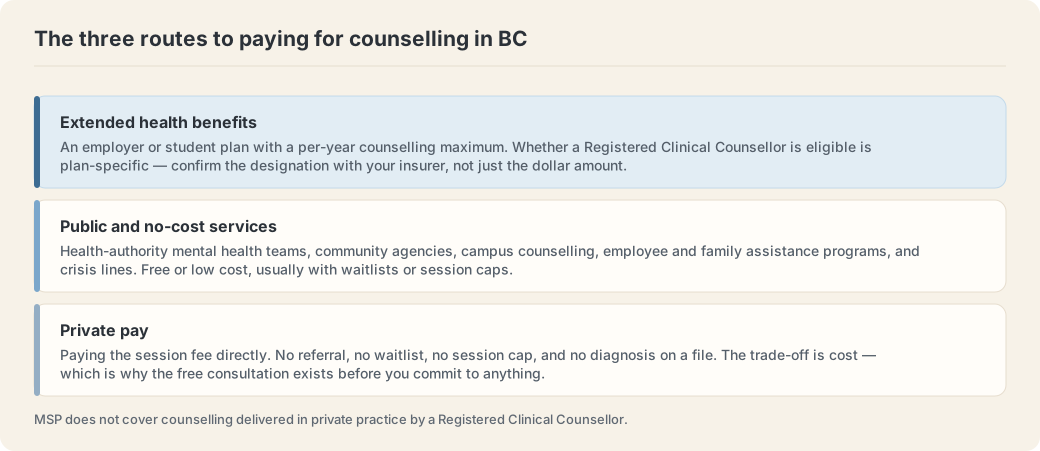
Choosing between public and private
- Cost is the deciding factor, Public services are free. If paying is not realistic and a waitlist is tolerable, start with your health authority or the free options in the low-cost guide.
- You need to start soon, Private practitioners can often begin within a week or two. This is the main thing people are buying.
- You need a diagnosis or medication, That is a physician or psychologist question, and the physician route is covered by MSP. A counsellor cannot do either.
- You want to choose your practitioner, Public services assign you a clinician. Private practice lets you pick, including for language, gender, and specific specialisation.
- You want long-term work, Public programs frequently cap the number of sessions. Private therapy can run as long as it is useful.
- Using both, Entirely normal and often sensible. A GP or psychiatrist handling the medical side while a counsellor does the talking work.
If you are weighing the wait against the cost, that is a reasonable thing to talk through on a free 15-minute call. Book a free consultation.
What MSP does cover, and how to reach it
It is easy to read "MSP does not cover counselling" and conclude the public system offers nothing. That is not accurate, and the routes it does fund are worth knowing.
Physician visits are covered, including appointments specifically about mental health. A family doctor or nurse practitioner can assess, prescribe, and refer, and for a substantial proportion of people that is the appropriate medical route without psychiatry being involved at all.
Psychiatry is covered, with a referral from a physician or nurse practitioner. Waits vary widely by region and urgency. Psychiatrists in BC largely provide diagnosis and medication management rather than ongoing psychotherapy, which is a common misunderstanding.
Health authority mental health and substance use services are free, delivered through Fraser Health, Vancouver Coastal, Island Health, Interior Health and Northern Health. Many accept self-referral. They are triaged by urgency, which means waits for non-urgent presentations can be long.
Hospital and emergency psychiatric assessment is covered, and urgent-response services operate in most regions.
What is not covered is counselling or psychotherapy delivered in private practice by a Registered Clinical Counsellor, and psychological assessment in private practice. That is the gap extended health, employer programmes and private pay fill, see low-cost counselling in BC for the routes when none of those apply.
If you have no coverage at all
A meaningful share of people in BC have neither extended health nor an employer programme: self-employed workers, contractors, part-time and gig workers, and anyone between jobs. The routes are narrower and they are not nothing.
Health authority services are free and accept self-referral in most regions. Waits are real and triaged by urgency, which is why accurate reporting at intake matters.
Community agencies in most regions offer counselling at reduced rates, often on a genuine income basis, and they are consistently under-used because they do not advertise.
Training clinics attached to graduate counselling and psychology programmes provide sessions at substantially reduced cost with supervised student clinicians. The supervision is close and the quality is frequently better than the price suggests.
Free structured programmes for low mood and anxiety exist, are coach-supported and have a real evidence base. Not therapy, and considerably better than a four-month gap.
Crisis and support lines are free, immediate, available at any hour, and legitimate for far more than emergencies.
Low-cost counselling in BC lists these in detail. And if you are self-employed, it is worth checking whether counselling is a deductible business expense or whether an individual health plan makes sense, a question for an accountant rather than a counsellor, and one people never think to ask.
Does MSP cover therapy?
The forty-word version, since this is the exact question that brings most people here: no, MSP does not cover counselling or therapy in private practice. It covers physician care, which includes psychiatrists reached by referral, and that is the whole of its mental-health reach for most adults.
What pays for therapy in BC instead: extended health benefits through work or school (the common route for Registered Clinical Counsellor sessions), specific entitlements where they apply: ICBC after a crash, CVAP for victims of crime, FNHA coverage, and the genuinely free and low-cost services that exist outside the fee system entirely. The rest of this page draws the boundary precisely, insurer by situation.
Common questions
Is counselling covered by MSP in BC?
No. The province’s own list of services not covered by MSP includes the services of counsellors and psychologists. MSP pays for physicians, so a GP visit about your mental health is covered, and so is a psychiatrist you are referred to. Counselling in a health authority program is free at the point of use; counselling in private practice is paid by you or by an extended health plan, depending on the plan.
Do MSP supplementary benefits cover counselling?
No. MSP’s supplementary benefits, for the people who qualify for them, are acupuncture, chiropractic, massage therapy, naturopathy, physiotherapy and non-surgical podiatry, as the province lists them. Counselling is not on that list.
Is therapy free in BC?
Some of it. MSP pays for a family doctor and, on referral, a psychiatrist. Counselling is free through a handful of public and community routes, all with waits and session limits: a few sessions through a community mental health team, employer assistance programs, and services such as Foundry for young people. Private counselling with a Registered Clinical Counsellor is not free, and many extended health plans reimburse it, depending on the plan; the fees page has every number.
Can my GP refer me to a counsellor and have MSP pay?
No. A GP referral does not convert private counselling into an MSP-covered service. A GP can, however, refer you into free health authority programs and to a psychiatrist, both of which are covered.
Does PharmaCare cover therapy?
No, PharmaCare covers eligible prescription medication, not counselling services.
Is anything covered if I am on income assistance?
Health authority mental-health services are free regardless of income, and some communities have additional no-cost counselling programs. Community and immigrant-serving agencies also run free counselling in many areas.
What about counselling for a crime I experienced?
The Crime Victim Assistance Program may fund counselling for victims of crime in BC, and it operates separately from MSP. Applying is worthwhile if that applies to you.
Sources
- Province of BC, Medical Services Plan
- Province of BC, services not covered by MSP: “services of counsellors or psychologists” (read 13 Oct 2026)
- Province of BC, services covered by MSP, including supplementary benefits (read 13 Oct 2026)
- Province of BC, mental health and substance use support
- HereToHelp BC, navigating the system
General information, not clinical, financial, or legal advice. Coverage and service details change, verify anything decision-critical directly with the provider or insurer. If you are in crisis, call or text 9-8-8 (Canada, 24/7) or 310-6789 for BC Mental Health Support.
Who you would talk to
Taking new clients and seeing people across BC by secure video. Each is a Registered Clinical Counsellor; the registration is on the profile and can be checked on the BCACC register.

Camille Granda, RCC, CCC
English and Tagalog · Trauma, Anxiety and chronic stress, Grief, loss and life transitions
In her words: “I want sitting with me to feel like the biggest belly breath you have ever taken.”

Savneet Singh, RCC
English and Punjabi · Anxiety, Depression, Trauma and attachment
In her words: “Comforting, safe and supportive, is what I aim for.”
Individual sessions are $140 for 50 minutes, after a free 15-minute consultation; card at booking.
Many extended health plans reimburse a Registered Clinical Counsellor, depending on the plan, so check yours; MSP does not cover private counselling. All fees.
Questions about cost or coverage?
A free 15-minute consultation is a good place to ask them, before committing to anything.
Book Free ConsultationNot ready to book? Send a line about what is going on. A reply comes within one business day.
Or a smaller step: What counselling costs in BC · What sessions cost · What the free 15 minutes is like
Looking on behalf of someone else? What to send them, and what not to, including the funded routes most people do not know they qualify for.
Keep reading
Related pages
Keep going
More BC resources
Where this leads
If this is close to your own situation, there is a page written for it: Counselling for newcomers to Canada, in BC.
Where you are
Online counselling across British Columbia
Every session is by secure video, so the counsellor you see does not depend on where you live. Each city page covers coverage, local public services and who is taking new clients there.