Guide · Relationships
Setting boundaries with family without detonating anything
Family boundaries are statements about what you will do, not rules imposed on someone else: “If the conversation turns into a criticism of my marriage, I am going to end the call.” A boundary does not require their agreement, and that is what makes boundaries workable with family members who will never consent to one. The hard part is not the wording; it is deciding in advance what you are prepared to follow through on, and accepting the cost.
Most boundary advice assumes a reasonable counterpart and a relationship you can afford to lose. Families frequently offer neither.
7 min read · Updated
Why the standard advice does not work here
The usual guidance: be clear, be direct, use "I" statements, assumes the other person will hear the request and adjust. With a colleague or a friend that is often true. With a parent who has related to you the same way for thirty-five years, it frequently is not, and following the advice produces a conversation that goes nowhere and leaves you feeling worse for having tried.
Families also carry two features that make this harder. They cannot easily be exited, so the option that makes boundaries enforceable elsewhere is off the table. And the relationship usually predates your ability to negotiate anything, so the pattern was set when you had no say in it.
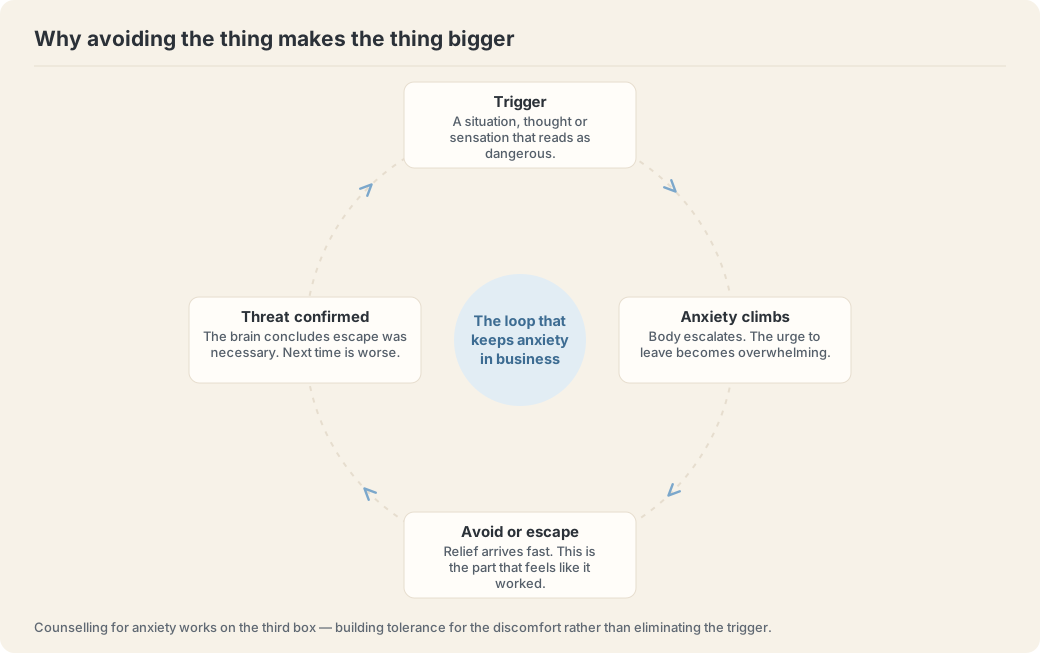
The result is a familiar loop: resentment builds, an attempt is made, it goes badly, you conclude boundaries do not work with your family, and the resentment resumes accumulating. The problem is usually not the family. It is that the thing being attempted is not actually a boundary.
What a boundary actually is
A boundary is a statement about your own behaviour under specified conditions. "If the conversation turns into a criticism of my marriage, I am going to end the call." That is a boundary, and its defining feature is that it is entirely within your control.
"You need to stop criticising my marriage" is a request. It might be a completely reasonable request. It is not a boundary, because whether it holds depends on somebody else's cooperation, which is precisely what you do not have.
This distinction is what makes boundaries possible with people who will never agree to them. You are not asking permission. You are describing what happens next, and then doing it. The other person retains the right to be furious about it, which they usually exercise.
Deciding before you speak
- What specifically is the problem?, "They do not respect me" cannot be acted on. "They comment on my weight at every meal" can. Boundaries need a definable trigger, or you will be enforcing something you cannot identify.
- What will you actually do?, It has to be something you are willing to carry out. Every time, including at Christmas, including when it is inconvenient. An unenforced boundary is worse than none, because it teaches that the statement is noise.
- What is it going to cost?, Guilt, escalation, other relatives recruited, a period of coldness. Deciding in advance whether that price is worth paying is the real work, and it is why this often takes several sessions rather than one good sentence.
- Are you doing it to change them?, If the boundary is a lever intended to produce an apology or a change of heart, it will fail and you will feel it as rejection. A boundary protects you. Any change in them is a bonus, not the objective.
- Is anyone at risk?, Where there is violence, coercive control, or financial control, general boundary advice is not the right tool and can be unsafe. That needs specialist support: VictimLinkBC at 1-800-563-0808, twenty-four hours a day, and 9-1-1 in immediate danger.
Saying it, and then the part nobody warns you about
The wording matters less than people think. Short, unapologetic, and without a case attached: "I am not going to discuss my weight. If it comes up, I will change the subject, and if it continues I will head off." Adding justification invites negotiation, and there is nothing to negotiate.
The part nobody warns you about is that the behaviour often gets worse before it changes, which is why follow-through, calmly and repeatedly, is the whole intervention. The first three enforcements are the ones that count; the first three months, further down, have a predictable shape.
When the other person will not accept it
Some family members will not adjust. The relationship then has to be reorganised around what is actually available rather than what you would want it to be: less contact, contact in specific settings, contact with an exit planned, or in some cases much less contact than the surrounding family finds acceptable.
Distance is also not the only outcome. Plenty of relationships improve considerably once the terms are honest, and a boundary held consistently for a year frequently produces a better relationship than a decade of resentful compliance did.
If you know what needs to change and cannot work out how to say it, that is exactly what a free consultation is for.
Where obligation and love are genuinely tangled
In many families, particularly where duty to parents is a core value rather than an optional one, the framing of boundaries as self-care lands badly, because it presumes an individualism that is not shared. Telling someone to prioritise themselves is not neutral advice; it is advice from one value system delivered into another.
The more useful question is usually not how to become less obligated, but which obligations you actually endorse and what they cost. People can carry a great deal willingly. What corrodes is carrying things nobody ever asked about, resenting it, and having no way to say so.
Working out which is which takes time and is difficult to do alone, particularly when the guilt arrives faster than the thought. Counselling for first-generation South Asian adults and intergenerational trauma both go further into this territory. Where the tangle runs through a marriage, with one partner caught between a parent and a spouse, couples and marriage counselling gives both of you the same room to say it.
What the first three months usually look like
Boundary work has a predictable arc, and knowing the arc is most of what stops people abandoning it in week three.
The first attempt goes badly. Almost always. The wording comes out wrong, or you over-explain, or you are talked out of it in the moment. That is not evidence that it will not work. It is the first attempt at a skill you have not practised, in front of the audience most likely to disrupt it.
Then comes the testing period. The behaviour frequently intensifies rather than stopping, because a boundary that has never been enforced is reasonably treated as noise. This is the phase people misread as proof it made things worse. It usually runs a few weeks and it is the phase where follow-through matters more than anything else you do.
Then other people get recruited. A sibling calls to say you have upset your mother. This is a family system attempting to restore its previous shape, and it is not a sign you were wrong. It does mean deciding in advance how much of that traffic you are willing to carry.
Then, often, quiet adjustment. Not agreement, not an apology. The system reorganises around the new terrain. People are frequently disappointed by this, because they wanted acknowledgement and got adaptation instead. Adaptation is the realistic outcome and it is worth a great deal.
And sometimes it does not adjust, and the relationship reorganises at a distance. That is a genuine loss and deserves grieving rather than being reframed as a win. Both endings are common, and neither is determined by how well you phrased the first sentence.
Boundaries that are not ultimatums
The word has been flattened by internet advice into something close to a threat, and that framing is both unpleasant to deliver and unnecessary. Most workable boundaries are considerably smaller.
A boundary can be about scope rather than access. "I am happy to talk about anything except my marriage" leaves the relationship entirely intact and removes the one subject that was destroying it.
It can be about timing. "I will call on Sundays" is a boundary. It sets a rhythm rather than a restriction, and it replaces an unpredictable demand with a reliable arrangement, which is frequently better for both people.
It can be about medium. Some relationships work considerably better by text than by phone, or in public than in private, or in short visits than long stays. Choosing the format is a boundary and it barely registers as one.
It can be unannounced. Not everything has to be declared. Changing what you disclose, how long you stay, or how quickly you reply is a boundary enacted rather than negotiated, and for some relationships that is the only version that will not trigger a confrontation.
Declared boundaries are necessary where a behaviour has to stop and the person has to know why. For a great deal of ordinary family friction, the quiet version does the work with a fraction of the cost, and it is worth trying before escalating to a conversation that will be remembered for a decade.
Common questions
Is setting a boundary the same as cutting someone off?
No, and they are frequently confused. A boundary defines the terms of continued contact. Ending contact is a separate and much larger decision.
What if the boundary makes things worse?
A period of escalation is common and usually temporary. It is a test of whether the new position holds. Sustained deterioration, or anything unsafe, is different and worth raising with a counsellor or a specialist service.
Do I have to explain my reasons?
No. Reasons invite debate about whether the reasons are good enough, which is not a debate that helps you. A boundary can be stated without a case.
What if my whole family sides against me?
That is common where a family system has organised around one person's behaviour for a long time. It is one of the more useful things to work on in counselling, because managing it alone is hard.
Sources
- Canadian Mental Health Association, BC Division
- VictimLinkBC
- HealthLink BC, mental health and substance use
This guide is general information, not clinical advice, and it cannot diagnose anything or replace an assessment. If you are in crisis, call or text 9-8-8 (Canada, 24/7) or BC Mental Health Support at 310-6789.
Who you would talk to
Taking new clients and seeing people across BC by secure video. Each is a Registered Clinical Counsellor; the registration is on the profile and can be checked on the BCACC register.

Camille Granda, RCC, CCC
English and Tagalog · Trauma, Anxiety and chronic stress, Grief, loss and life transitions
In her words: “I want sitting with me to feel like the biggest belly breath you have ever taken.”

Savneet Singh, RCC
English and Punjabi · Anxiety, Depression, Trauma and attachment
In her words: “Comforting, safe and supportive, is what I aim for.”
Individual sessions are $140 for 50 minutes, after a free 15-minute consultation; card at booking.
Many extended health plans reimburse a Registered Clinical Counsellor, depending on the plan, so check yours; MSP does not cover private counselling. All fees.
Still deciding?
A free 15-minute consultation is the least committal way to find out whether this is a fit. No pressure, and no obligation to book a session afterward.
Book Free ConsultationNot ready to book? Send a line about what is going on. A reply comes within one business day.
Or a smaller step: What sessions cost · What the free 15 minutes is like
Looking on behalf of someone else? What to send them, and what not to, including the funded routes most people do not know they qualify for.
Where this leads
If this is close to your own situation, there is a page written for it: When you and your parents cannot find each other.
Where you are
Online counselling across British Columbia
Every session is by secure video, so the counsellor you see does not depend on where you live. Each city page covers coverage, local public services and who is taking new clients there.