Guide · Emotions
Anger that arrives before you notice it
Anger is fast because it is a threat response, and threat responses are built to outrun deliberation. That means the useful work happens before and after the flashpoint rather than during it: noticing the earlier physical signals, reducing the background load that lowers your threshold, and addressing whatever the anger is standing in front of, which is often fear, shame or exhaustion.
The problem is rarely that you got angry. It is that you were already three sentences in before you knew it was happening.
7 min read · Updated
Why is anger faster than you are?
Anger is not a failure of self-control that better willpower would fix. It is a threat response, and the systems that generate it operate faster than the systems that evaluate whether the threat is real. By the time you are consciously deciding how to respond, your body has already committed: heart rate up, muscles loaded, attention narrowed onto the perceived source.
This is why advice to count to ten fails so consistently. It assumes a moment of choice that has already passed. The window in which a decision is genuinely available is much earlier, and it is physical rather than verbal: jaw, shoulders, breath, heat, the particular tightening that happens fifteen seconds before you say anything.
What that means practically: the work is not "manage anger in the moment". It is learning your own early signals, and reducing the background load that lowers your threshold, so the moment arrives less often and less far along.
What anger is usually standing in front of
Anger is frequently a second emotion. It is quick, it is energising, and it points outward, which makes it considerably more tolerable than what it replaced. Underneath, most of the time, is one of a short list:
- Fear, Something you cannot control is threatened, a job, a relationship, a child. Anger converts a helpless feeling into an active one, which is why it arrives instead.
- Shame, The most common and the least visible. Being caught out, exposed, or made small produces anger almost instantly, because anger is the only version of that experience that does not require you to feel small.
- Exhaustion, Not psychological at all. A depleted nervous system has a much lower threshold, which is why the same remark is nothing on Tuesday and unbearable on Friday.
- Grief, Anger is a standard feature of grief and one of the least expected. Frequently directed at the person who died, which is disorienting and entirely normal.
- A boundary crossed repeatedly, Sometimes anger is not a symptom of anything. It is accurate information about a situation that has been unacceptable for two years and never been said.
What actually helps
- Learn the early signals, Not the emotion. The body. Most people can identify a specific physical precursor once they start looking, and it typically arrives well before speech does. That is the actual decision point.
- Reduce the background load, Sleep, alcohol and unmanaged stress do more to determine your threshold than any in-the-moment technique. Anger that only appears at the end of bad weeks is a load problem, not an anger problem.
- Leave properly, not dramatically, A planned exit: "I need twenty minutes, I am coming back", works. Storming out does not, because it reads as abandonment and adds a second problem. The distinction is agreeing it in advance, when nobody is angry.
- Move, Anger loads the body for action. A brisk walk metabolises the adrenaline in a way that sitting with it does not. This is physiological rather than motivational.
- Say the underlying thing later, The conversation that actually resolves something almost never happens during the flashpoint. It happens two hours afterwards, and it is about the fear or the shame rather than about the dishes.
- Track the pattern, A fortnight of brief notes, when, what preceded it, how tired you were, usually reveals a structure that is invisible from inside the week.
What does not help
Two widely repeated pieces of advice are worth discarding. The first is venting, hitting something, shouting it out, on the theory that anger is a pressure that must be released. The evidence does not support it; rehearsing the physical expression of anger tends to make it more available rather than less.
The second is suppression as a strategy. Swallowing it consistently does not remove it; it converts it into resentment, physical tension, or a flatness that other people read as coldness. Both extremes fail for the same reason: they treat anger as a substance to be dealt with rather than a signal to be understood.
A third thing worth naming: anger management courses are frequently mandated rather than chosen, and a course you are attending to satisfy somebody else is unlikely to change much. Voluntary work on it is a substantially different exercise.
If the pattern has started costing you relationships rather than just evenings, a free 15-minute consultation is a reasonable next step.
When it is more than an anger problem
If anger has become physical toward a partner, a child or anyone else, including throwing things, blocking a doorway, or damaging property. That is beyond what a general counselling page should be addressing, and it needs specialised intervention rather than skills practice. It is also, importantly, still addressable: programmes exist for exactly this and people do change. In immediate danger, 9-1-1; VictimLinkBC is available at 1-800-563-0808 twenty-four hours a day for anyone affected.
Anger that arrived suddenly and out of character, particularly alongside changes in sleep, memory or personality, warrants a medical assessment first. Several physical conditions and some medications present this way.
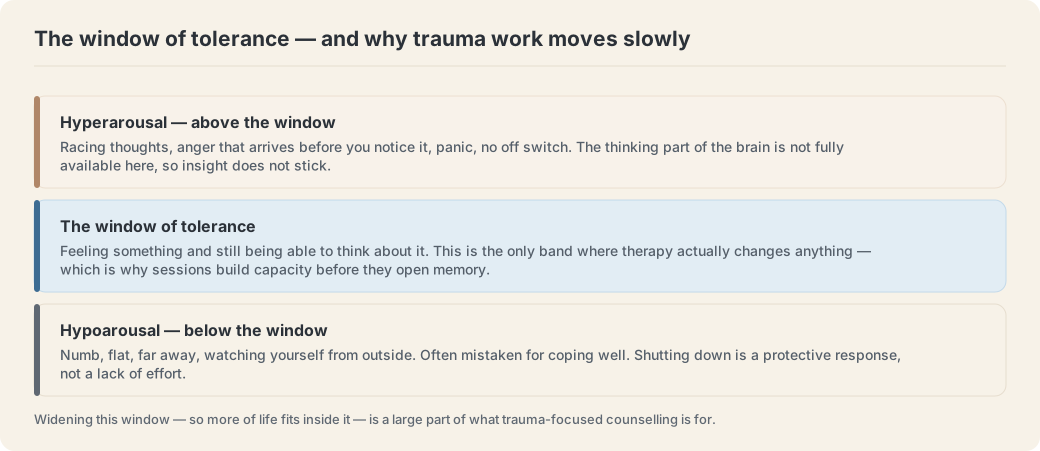
And where anger is the visible surface of something older: hypervigilance, a nervous system that never stood down, a childhood organised around someone else's temper. The more direct route is usually trauma therapy rather than anger-specific work. What trauma actually means covers why insight alone so often fails to shift it.
The repair conversation afterwards
What happens after an episode matters more for a relationship than what happened during it, and most people handle the aftermath in one of two unhelpful ways: over-apologising in a way that demands reassurance, or moving on silently and hoping it recedes.
A repair that works has four parts and takes about three minutes. Name it without excusing it, "I was sharp with you last night and that was not okay." No "but you", no explanation of provocation; the moment a reason arrives, the apology becomes a defence.
Say what it was actually about, if you know. "I was already at the end of it before you said anything." This is not an excuse. It is information, and it is what allows the other person to stop interpreting it as a verdict on them.
Ask what it was like for them, and then genuinely listen rather than waiting to correct the account. This is the part most people skip and the part that does most of the work.
Say what you are going to do differently, specifically and modestly. "I am going to say I need twenty minutes rather than staying in the room" is worth more than a promise never to lose your temper, which nobody can keep and which therefore devalues the next apology.
Timing matters. Too soon and you are both still activated; too late and the silence has become its own event. A few hours is usually about right. And repair is cumulative, a pattern of reliable repair after mistakes builds more trust than an unbroken record of never making one, which is not on offer to anybody.
The two-week anger log
Anger is unusually responsive to being recorded, largely because the pattern is invisible from inside the week and obvious on a page.
Record five things each time it happens, briefly. When. What preceded it. The trigger, and also the hour, the sleep, the day. How fast it arrived, from zero to ten. What you did. And what it was about underneath, filled in afterwards rather than during.
Two weeks of that reliably produces findings people did not expect. The most common is that it is almost never about the stated trigger. The same remark passes without comment on Tuesday and detonates on Friday, which means the variable is load rather than provocation.
The second common finding is a specific precursor state. Hungry, under-slept, or four hours into a day with no break. Anger that only appears in that state is a capacity problem with a straightforward intervention, and it is astonishing how many people have never connected the two.
The third is the relational pattern: it happens with one particular person, or in one particular role, or only at home after a day of suppression at work. That points somewhere useful and it is not visible without the record.
The log also does something beyond diagnosis. Recording an episode requires standing slightly outside it, and people frequently report that the act of tracking reduces the frequency before any technique has been applied at all.
Common questions
Is anger a mental health problem?
Anger is a normal emotion, not a disorder in itself. It becomes a clinical concern when its intensity, frequency or expression is damaging your relationships, your work or your health.
My partner says I need anger management. Should I go?
Being told is a poor motivator, and that is worth saying honestly. It is usually more productive to start from your own account of what is happening than from someone else's diagnosis of it.
Why am I only angry at home?
Extremely common, and it is usually about where suppression is affordable. Anger held all day at work has to go somewhere, and home is the place with the least immediate cost.
Can counselling actually change this?
The patterns underneath anger: threshold, early signals, and what it is protecting, are workable. Nobody can promise an outcome, and a counsellor who does is misrepresenting the work.
Sources
- Canadian Mental Health Association, BC Division
- HealthLink BC, mental health and substance use
- VictimLinkBC
This guide is general information, not clinical advice, and it cannot diagnose anything or replace an assessment. If you are in crisis, call or text 9-8-8 (Canada, 24/7) or BC Mental Health Support at 310-6789.
Individual sessions are $140 for 50 minutes, after a free 15-minute consultation; card at booking.
Many extended health plans reimburse a Registered Clinical Counsellor, depending on the plan, so check yours; MSP does not cover private counselling. All fees.
There is no wrong way to start.
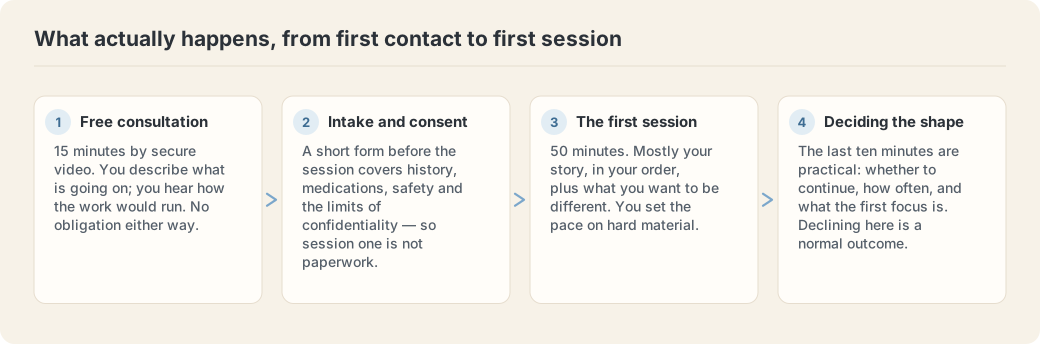
A free 15-minute consultation over secure video, whenever you are ready for one. Nothing is committed by having it, and no card is needed to book it.
Book Free ConsultationNot ready to book? Send a line about what is going on. A reply comes within one business day.
Or a smaller step: What sessions cost · What the free 15 minutes is like
Looking on behalf of someone else? What to send them, and what not to, including the funded routes most people do not know they qualify for.
Where this leads
If this is close to your own situation, there is a page written for it: Counselling for tradespeople and construction workers in BC and Counselling for men in BC.
Where you are
Online counselling across British Columbia
Every session is by secure video, so the counsellor you see does not depend on where you live. Each city page covers coverage, local public services and who is taking new clients there.