Guide · Couples
How the Gottman Method works in couples therapy
The Gottman Method is a structured, research-derived approach to couples therapy. It begins with a formal assessment, identifies specific destructive patterns: criticism, contempt, defensiveness, stonewalling, and teaches concrete replacements. It is skills-based rather than insight-based: couples leave with things to do, not only things to understand.
Built on decades of watching couples argue in a lab, and unusually specific about what predicts trouble.
7 min read · Updated
Where it came from
Most couples therapy grew out of clinical theory. The Gottman Method grew out of observation, decades of research watching couples interact under controlled conditions, recording not just what they said but heart rate, facial expression, and tone, then following them for years to see which relationships lasted.
That produced something unusual: an approach built on what actually distinguished couples who stayed together and happy from those who did not. The practical consequence is that the method is specific. Rather than "improve communication", it names particular behaviours that predict difficulty and teaches particular replacements.
The Four Horsemen
The best-known part of the model is a set of four communication patterns that research found strongly associated with relationship breakdown. Recognising them is usually the first thing couples take away:
- Criticism, Attacking character rather than raising a behaviour. "You never think about anyone but yourself" rather than "I felt alone when you made that plan without me." The replacement is a complaint about a specific action, stated from your own experience.
- Contempt, Eye-rolling, mockery, sarcasm, name-calling, communication from a position of superiority. This is the single strongest predictor in the research, and the antidote is deliberate: actively building a culture of appreciation, which sounds soft and is the hardest one to rebuild.
- Defensiveness, Meeting a complaint with counter-attack or innocent victimhood. It reads as self-protection and functions as blame-return. The replacement is accepting some part of the responsibility, even a small part.
- Stonewalling, Withdrawing, shutting down, going silent. Usually it is physiological flooding rather than indifference. The person is overwhelmed and has gone offline. The replacement is a proper break, agreed in advance, with a stated time to return.
What actually happens in the sessions
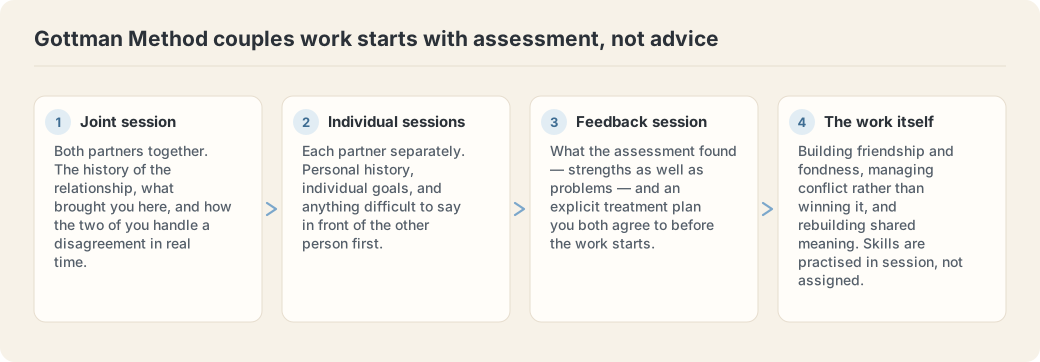
Gottman work usually starts with a structured assessment rather than diving straight in: a joint session, individual sessions with each partner, and questionnaires covering friendship, conflict, and shared meaning. The couple then gets fed back a picture of where the relationship is strong and where it is stuck, which is often the first time both people have seen the same map.
From there the work targets specific areas: managing conflict that can be solved and learning to live with the conflict that cannot (research suggests a large share of relationship conflict is perpetual rather than solvable), rebuilding friendship and knowledge of each other, and repairing after ruptures. Sessions typically involve doing things in the room, structured conversations with the counsellor interrupting patterns in real time, rather than only reporting on the week.
On flooding: a lot of Gottman work is physiological. When heart rate rises past a certain point, people stop being able to take in new information, which is why arguments at that stage go nowhere. Learning to notice it and stop before it happens is often the single most useful thing a couple takes from the work.
Who it fits, and when it is not the right call
It suits couples stuck in recurring arguments, couples who have drifted into logistics, couples rebuilding after a breach of trust, and couples facing a decision they keep failing to have a productive conversation about. It works whether or not both partners are certain they want to stay, clarity is a legitimate goal.
It is not the right first move where there is ongoing violence or coercive control. Couples therapy in that context can increase risk, and a responsible practitioner will screen for it in the individual sessions and redirect. It is also difficult when one partner has already decided to leave and is using sessions to soften the exit, worth naming out loud rather than discovering three months in.
Some concerns are better addressed individually first. If one partner is dealing with untreated trauma, depression, or an addiction, individual therapy running alongside or before couples work is often the more effective sequence.
Finding a Gottman-method counsellor in British Columbia
Gottman training runs in three levels, and a counsellor may have completed one, two or all three without being a Certified Gottman Therapist, which is a further and much longer process. Neither is a licence: the regulated credential in BC is the Registered Clinical Counsellor designation, and the Gottman training sits on top of it. It is entirely reasonable to ask a prospective counsellor which level they have completed and how much of their practice is couples work.
At this practice, Gottman-informed couples counselling in BC is delivered online across British Columbia by a Registered Clinical Counsellor, which removes the usual difficulty of finding two people free at the same hour in the same city. The Gottman Institute's own referral directory lists clinicians by region and training level if you want to compare. For how the method sits against the other major evidence-based couples approach, the Gottman vs EFT comparison sets the two side by side. The first 15-minute consultation is free and both partners are welcome on it.
Not sure whether to start with couples sessions or individually? That is worth fifteen minutes before committing either way. Book a free consultation.
The Four Horsemen, and what replaces them
The best-known part of this research is a set of four communication patterns that predict relationship breakdown with unusual reliability. They are worth knowing because they are specific enough to notice in yourself, which is the first move.
Criticism attacks the person rather than the behaviour, "you never think about anyone else" rather than "I was upset that you did not call". The antidote is a complaint with a request attached: what happened, how you felt, what you would like instead.
Contempt is the most corrosive of the four and the strongest single predictor of separation. Eye-rolling, mockery, sarcasm, name-calling, communication from a position of superiority. Its antidote is not politeness; it is the deliberate, sustained rebuilding of fondness and admiration, which is slower work.
Defensiveness is a counter-attack disguised as self-protection, and it reliably escalates. The antidote is accepting some portion of responsibility, even a small one, which nearly always de-escalates faster than being right does.
Stonewalling is withdrawal: shutting down, going silent, leaving the room. It is usually a sign of physiological flooding rather than indifference, and the antidote is a self-soothing break that is announced and time-limited rather than an exit.
A relationship containing all four is not doomed; it is a relationship where the work is clear. The point of naming them is that they are behaviours rather than character, and behaviours can be replaced.
What "most conflict is unresolvable" actually means
One of the more counter-intuitive findings in this research is that a large share of the disagreements in any long relationship are perpetual: rooted in stable differences of personality, values or need, and not going away. Tidiness, sociability, money, sex, how much time family gets. Couples who stay together are not couples who solved these; they are couples who developed a way of talking about them that does not produce damage.
That reframing removes a great deal of pressure. If you have been having the same argument for eight years, that does not necessarily mean either of you is unreasonable or that the relationship has failed. It means you have located a perpetual issue and have not yet found a workable way to hold it.
The clinical distinction is between gridlock and dialogue. Gridlocked conflict is characterised by feeling rejected, entrenchment, and a total absence of humour. The same issue in dialogue still recurs and it is survivable. You can discuss it, tease each other about it, and get through the conversation without either of you feeling diminished.
Moving a gridlocked issue into dialogue usually requires understanding what the position means to the other person. The history, the value, the fear underneath it. That is often a session or two of work, and it is a different activity from negotiating a compromise.
Repair attempts, and why they matter more than conflict style
One of the more useful findings in this research is that couples who do well are not the ones who argue less or more politely. They are the ones whose repair attempts get received.
A repair attempt is anything that tries to de-escalate mid-conflict: a joke, an apology, a hand on an arm, "can we start that again", a deliberate softening. Every couple makes them. The difference between couples who recover and couples who spiral is whether the other person accepts one when it is offered.
That reframes the practical work considerably. Rather than trying to have better arguments, which is difficult under load. The higher-leverage move is to make repair attempts easier to spot and harder to refuse. Some couples agree an explicit signal for exactly this reason: a word, a gesture, something unmistakable that means I am trying to stop this, which cannot be missed in the way a joke can.
Refusing repair is usually not spite. It is frequently physiological: once someone is flooded, they cannot receive an olive branch, and pushing harder makes it worse. Which is why the agreed break matters: twenty minutes announced in advance, then a return, is what makes repair possible at all.
The other half is the ratio. This research consistently finds that stable relationships run a large surplus of positive to negative interactions during conflict, not in general, but during the argument itself. That surplus is built in ordinary time, not in the fight. Which is why the work spends so much of its attention on friendship and fondness, and why couples who arrive expecting conflict techniques are often surprised by where the sessions go first.
Common questions
Is Gottman Method marriage counselling available in British Columbia?
Yes. Westpeak Wellness delivers Gottman Method-informed couples counselling by secure video anywhere in BC, so it does not depend on which city you live in; both partners can join from the same room or from different places. The Gottman Institute's own referral directory also lists clinicians by training level, and a counsellor's page should say what level they hold.
What is the difference between the Gottman Method and emotionally focused therapy?
Both are research-supported. EFT works primarily on the attachment bond and the emotions underneath a couple's cycle; the Gottman Method is more skills-based, working on the observable patterns of conflict and connection. Many clinicians draw on both. There is a fuller comparison at /compare/gottman-method-vs-eft-for-couples.
Does my partner have to want to come?
For couples work, yes. It does not function with one willing participant. But individual therapy about a relationship is legitimate and useful in its own right, and sometimes changes the dynamic enough that the other person becomes willing.
Will the counsellor take sides?
No. The method is explicitly structured to avoid it, which is part of why the assessment includes individual sessions with each partner. If you consistently feel ganged up on, say so. That is a problem with the work, not a normal feature of it.
How long does couples therapy take?
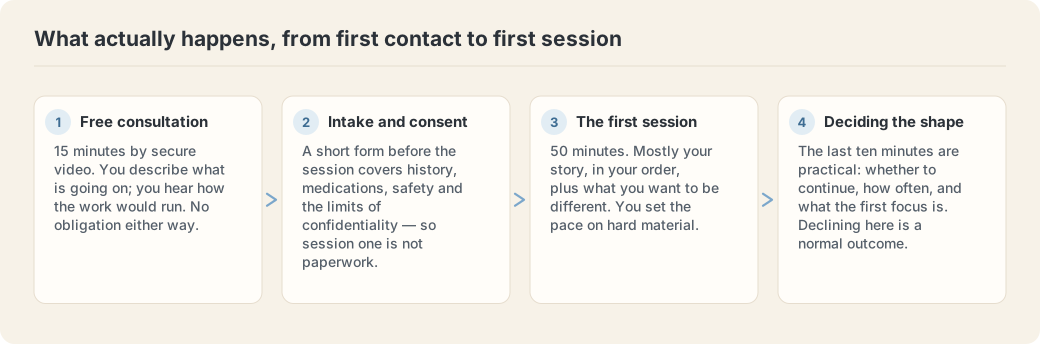
Assessment alone typically takes two to four sessions. Beyond that it varies enormously with what you are working on. Couples with a specific stuck pattern often see change faster than couples repairing after a significant breach.
Can couples therapy work over video?
Yes, and it solves a real logistical problem, two people no longer have to be in the same place at the same time to attend. Partners can even join from separate locations when schedules require it.
Sources
This guide is general information, not clinical advice, and it cannot diagnose anything or replace an assessment. If you are in crisis, call or text 9-8-8 (Canada, 24/7) or BC Mental Health Support at 310-6789.
Who you would talk to
Taking new clients and seeing people across BC by secure video. Each is a Registered Clinical Counsellor; the registration is on the profile and can be checked on the BCACC register.

Camille Granda, RCC, CCC
English and Tagalog · Couples counselling, Trauma, Anxiety and chronic stress
In her words: “I want sitting with me to feel like the biggest belly breath you have ever taken.”
Couples sessions are $175 for 50 minutes; a 110-minute extended session is $340, after a free 15-minute consultation; card at booking.
Many extended health plans reimburse a Registered Clinical Counsellor, depending on the plan, so check yours; MSP does not cover private counselling. All fees.
Still deciding?
A free 15-minute consultation is the least committal way to find out whether this is a fit. No pressure, and no obligation to book a session afterward.
Book Free ConsultationNot ready to book? Send a line about what is going on. A reply comes within one business day.
Or a smaller step: Which kind of counselling fits? · What sessions cost · What the free 15 minutes is like
Looking on behalf of someone else? What to send them, and what not to, including the funded routes most people do not know they qualify for.
Where this leads
Online couples and marriage counselling across BC
The practice is virtual, so the same counsellors see people in every one of these cities. Each page says what the service involves there and who is taking new clients.
Where you are
Online counselling across British Columbia
Every session is by secure video, so the counsellor you see does not depend on where you live. Each city page covers coverage, local public services and who is taking new clients there.