For · Punjabi-speaking couples
Punjabi-speaking couples counselling in BC
Couples counselling online across BC for couples whose marriage involves two families rather than two people. Sessions for the two of you together run in English with Camille Granda, RCC, CCC; either partner can also have individual sessions in Punjabi with Savneet Singh, RCC. In-laws are not treated as the diagnosis, and an arranged marriage is not treated as a problem to be fixed.
Where the in-laws do not have to be explained first, and a marriage that began through two families is not treated as the problem.
7 min read · Updated
Many extended health plans reimburse a Registered Clinical Counsellor, depending on the plan, so check yours; MSP does not. Receipts are issued for every session, and the fees are published in full. On a calendar-year plan, sessions held by 31 December count against this year: using benefits before the plan year ends.
Couples sessions are $175 for 50 minutes; a 110-minute extended session is $340, after a free 15-minute consultation; card at booking.
Most couples counselling is built around a two-person system: two partners, each with their own needs, negotiating with each other. It is a good model, and for a lot of couples it is the right one.
It is also not what many Punjabi-speaking couples walk in with. The marriage sits inside two families, often inside a shared household, and frequently inside two sets of expectations about what a good husband, wife, son and daughter-in-law owe. Nobody in the room chose that arrangement and it does not go away because a counsellor finds it inconvenient to model.
This is couples work that starts from there rather than arriving at it in session six. Sessions for the two of you together run in English with Camille Granda: book a couples consultation with Camille. Either of you can also have individual sessions in Punjabi with Savneet Singh: book an individual consultation with Savneet.
What comes up
The things people actually say
Arguments that get translated before they get discussed
A row that happened in Punjabi, reconstructed in English for a counsellor, arrives flattened. The tone, the exact word, the thing that actually stung. Both partners then spend the session arguing about the translation rather than the argument.
In-laws as a third party in the marriage
Not a villain and not a footnote. A living arrangement, a set of obligations, and a genuine relationship that both partners may want to protect while also needing something to change inside it.
Two different scripts for the same role
What a husband owes his parents. What a wife owes her in-laws. Whether earning changes either. Two people can hold entirely different versions of these and have never once said them out loud, because both assumed theirs was simply what everyone thought.
The reputational cost of being in counselling at all
For many couples the fear is not the counselling. It is somebody finding out, and what that would be taken to mean about the marriage. This is a large part of why couples arrive later than they would like to have.
Migration strain that never got named
Arriving, credentials not recognised, working below your training, a spouse waiting years on immigration. The stress was survived rather than discussed, and the marriage absorbed it.
Intimacy and children, in a house with no privacy
Conversations that are hard anywhere are harder in a multigenerational home. Sometimes the practical constraint is the whole problem, and naming it is most of the work.
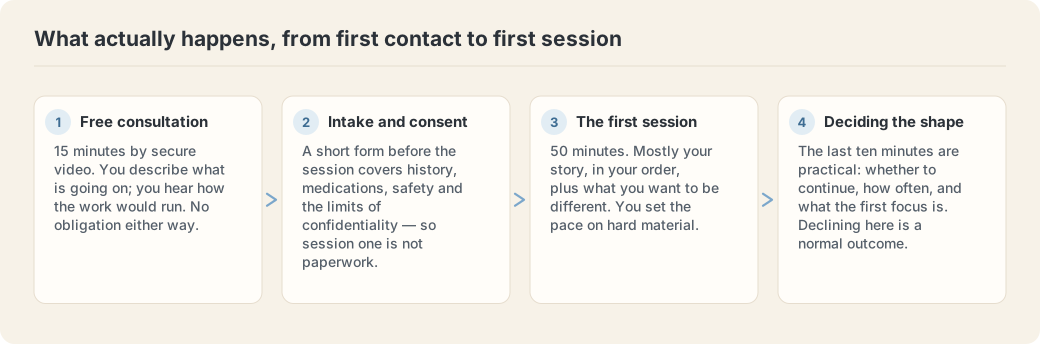
A free 15-minute consultation is a conversation about whether this is the right fit, and both of you are welcome on it. Nothing is assessed and nothing is decided on the call. Book a free consultation.
What language changes in couples work specifically
In individual counselling, working in a second language costs precision. In couples counselling it costs something more: the ability to show your partner what you meant.
A couple who argue in Punjabi and then describe it in English are doing simultaneous translation in the middle of a difficult conversation, while upset, in front of a third person. The version that reaches the counsellor is the calm, edited one, and the counsellor then works on the edited version, which is not the marriage.
Couples sessions here currently run in English, so that cost is worth naming in the first session rather than working around. A partner who would rather think something through in Punjabi first can do that in individual sessions alongside the couples work.
The family is not treated as the diagnosis
A great deal of counselling written for Western couples treats extended-family involvement as enmeshment. A boundary problem, with the healthy outcome being more separation. Applied without thought to a family that lives together by choice and by culture, that reads as being told your family is the illness.
The working position here is narrower and more useful: family involvement is neither healthy nor unhealthy in itself. What matters is whether the two of you agree about it, whether the arrangement is one you both actually chose, and whether either of you is carrying a cost you have never said aloud. Sometimes the answer is a change in the family arrangement. Often it is a change in what the two of you have agreed between yourselves about it.
What will not happen is being told that the obvious solution is to move out and care less. That advice ends the conversation, and most people who have heard it once do not come back for more of it.
Arranged and family-introduced marriages
A marriage that began through families is not a marriage with a problem in it, and it is not what the work is about unless you say it is.
What does come up, and is worth naming, is that couples who married this way sometimes arrive without a shared history of having negotiated things privately, the practice of working out what the two of you want, separately from what either family expects, may simply not have been established. That is a skill rather than a flaw, and it is learnable.
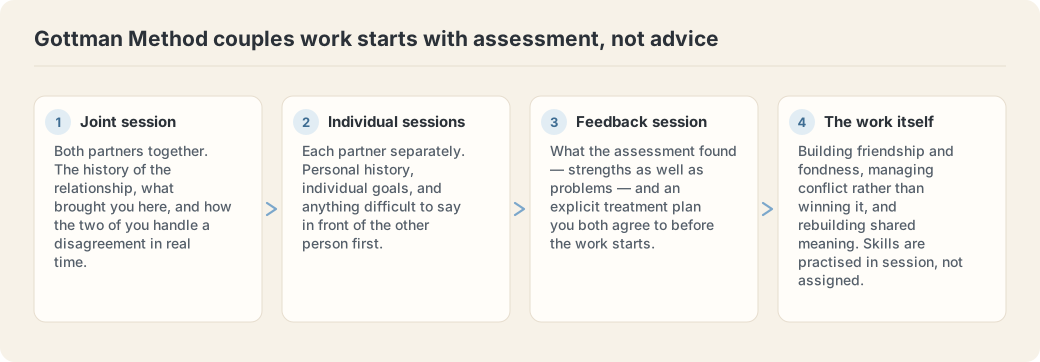
How the sessions actually run
- Both partners, together, Couples work is joint. Individual sessions may occasionally make sense alongside it, but the practice will not hold private information from one partner about the other. That arrangement damages the work and is declined rather than negotiated.
- Gottman-informed, A structured method for how conflict actually goes between two people, adapted to the situation in front of it rather than applied off the shelf. Named as an approach used, not as a promise about outcomes.
- 50 or 110 minutes, The extended session exists because couples work often needs longer than fifty minutes to get anywhere and come back. Many couples do the first session extended and then move to the standard length.
- Two rooms is fine, Partners can join from separate locations: different houses, one on shift, one travelling. For couples separated by immigration timelines this is sometimes the only way the work can happen at all.
- Nothing is diagnosed, Counselling is not assessment. If something in the picture needs a physician or a psychologist, that is said plainly and pointed toward.
Privacy, when the community is small
For couples in Surrey, Abbotsford or Delta the practical question is often not whether to get help but whether it can be done without anybody knowing. That is a reasonable thing to want and it is not evidence of shame.
This practice has no office anywhere, so there is no waiting room to be seen in, and no professional or social overlap with the Lower Mainland South Asian community. Sessions are held by secure video and nothing is posted to a home address. The limits of confidentiality are the legal ones set out on standards and scope, and they are the same regardless of who asks.
The honest caveat is the one nobody mentions: the most common way people are found out is their own device. A shared laptop, a phone somebody else opens, a browser history. Worth a thought before the first session rather than after it.
Who you would see
Taking new clients and seeing people across BC by secure video. Each is a Registered Clinical Counsellor; the registration is on the profile and can be checked on the BCACC register.

Camille Granda, RCC, CCC
English and Tagalog · Couples counselling, Trauma, Anxiety and chronic stress
In her words: “I want sitting with me to feel like the biggest belly breath you have ever taken.”
Where to start
Services that tend to fit
Couples counselling
Fifty minutes, both partners, in English. The standard format most couples settle into.
Punjabi-speaking counselling
The practical detail on how language works in sessions, including switching mid-sentence.
EMDR
Where one partner is carrying a trauma that keeps arriving in the marriage, individual EMDR alongside couples work is sometimes the more direct route.
Common questions
Can one of us speak mostly Punjabi and the other mostly English?
Couples sessions currently run in English, so the two of you would work in English together. A partner more at ease in Punjabi can have individual sessions in Punjabi alongside the couples work.
Will we be told to move out or cut off family?
No. Family involvement is not treated as the diagnosis. What matters is whether the two of you agree about the arrangement and whether either of you is carrying a cost that has never been said out loud, and the answer to that is often a change between the two of you rather than a change to the family.
Is an arranged marriage treated as a problem?
No. A marriage that began through families is not a marriage with something wrong in it, and it is not the subject of the work unless you make it so.
Can we join from different places?
Yes. Partners can be in separate locations, which matters for shift work, travel, and for couples separated by immigration timelines. Both need to be physically in BC at the time of the session.
Will our families find out?
Not from this practice. There is no office and no waiting room, sessions are by secure video, and nothing is sent to a home address. Confidentiality carries the legal limits set out on the standards page. The realistic risk is a shared device rather than anything at this end.
What does it cost, and is it covered?
Couples counselling is $175 for 50 minutes, or $340 for the 110-minute extended session. Many BC extended health plans that cover a Registered Clinical Counsellor cover couples sessions, though some exclude them specifically. It is worth checking the wording before booking. Receipts carry the RCC registration number.
Sources and further support
- Statistics Canada, Census Profile, 2021 Census: Surrey, City (CY), British Columbia
- BC Association of Clinical Counsellors, Find a Counsellor
General information, not clinical advice, and not a diagnosis. If you are in crisis, call or text 9-8-8 (Canada, 24/7) or BC Mental Health Support at 310-6789. In immediate danger, call 911.
Keep going
Written for other situations
Where you are
Online counselling across British Columbia
Every session is by secure video, so the counsellor you see does not depend on where you live. Each city page covers coverage, local public services and who is taking new clients there.
One conversation, no commitment.
A free 15-minute consultation over secure video, including an honest answer if something other than counselling would serve you better.
Book Free ConsultationNot ready to book? Send a line about what is going on. A reply comes within one business day, or read the guides first and come back when you want to.
Looking on behalf of someone else? What to send them, and what not to, including the funded routes most people do not know they qualify for.