Who we work with
Counselling for people caring for a parent
Counselling for family caregivers in BC: people looking after a parent, partner or adult child. Covers resentment that feels unspeakable, anticipatory grief, and the fact that the person doing the caring is usually the last one anybody asks about.
Nobody applies for this job. It accretes, one appointment, then the medications, then everything.
7 min read · Updated
Many extended health plans reimburse a Registered Clinical Counsellor, depending on the plan, so check yours; MSP does not. Receipts are issued for every session, and the fees are published in full. On a calendar-year plan, sessions held by 31 December count against this year: using benefits before the plan year ends.
Individual sessions are $140 for 50 minutes, after a free 15-minute consultation.
Family caregiving almost never begins with a decision. It begins with a hospital discharge, or a fall, or a diagnosis, and then a series of small assumptions of responsibility that nobody formally agreed to and that add up over a couple of years into something enormous.
It is also usually invisible. There is no title, no hours, and no acknowledgement of it as work, which makes it difficult to say that it has become too much without feeling as though you are complaining about loving someone.
What brings people here is rarely the tasks. It is the combination: exhaustion, grief for someone who has not died, anger with nowhere acceptable to put it, and a relationship with a sibling that has quietly become unrecoverable.
What comes up
The things people actually say
Anticipatory grief
Mourning someone who is still here. Common in dementia in particular, where the person is present and progressively less recognisable, and where each stage is a fresh loss with no ritual attached.
Resentment, and the guilt about it
The most reliably unspoken item in the list. Resenting a parent you love, or a sibling who does nothing, or the situation itself, and then feeling monstrous for it.
The sibling problem
One person doing almost everything while others contribute opinions. Old family roles reassert themselves under pressure with remarkable precision.
Role reversal
Making decisions for a parent, managing their money, overriding their preferences for their safety. It is disorienting in a way that surprises people, and it disturbs a relationship that was arranged the other way round for forty years.
A vanished life
Career slowed or stopped, friendships lapsed, holidays cancelled, own health deferred. Usually noticed only when someone asks what you have been doing.
Decisions with no good option
Care homes, feeding, resuscitation, driving. Choices where every path costs something and where you will be the one who chose.
Caring in both directions
Children still at home and a parent declining. Two sets of appointments, usually alongside a job.
What happens afterwards
The collapse that frequently arrives after it ends, when the structure that organised years of your life stops, and the relief that comes with it, which is nearly impossible to admit to anyone.
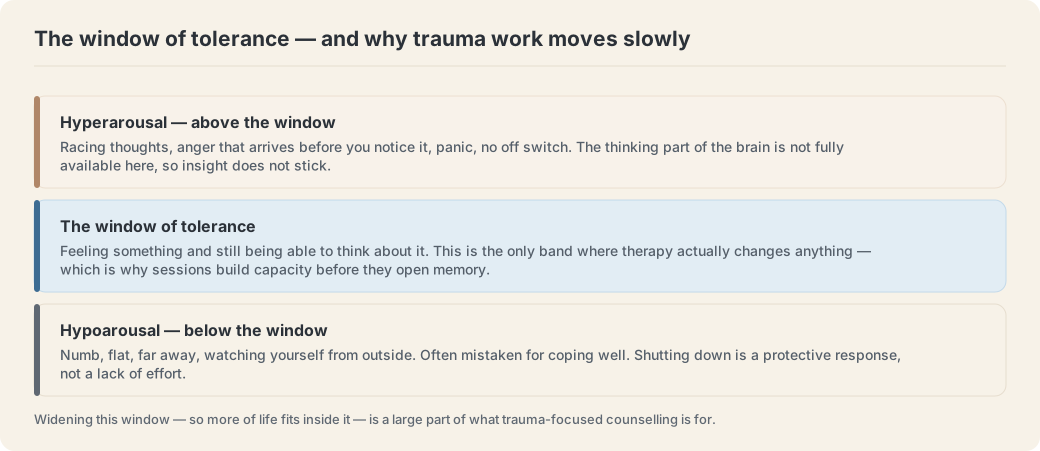
If nobody has asked how you are doing in about two years, a free 15-minute consultation is a place to start.
Why this is so hard to bring anywhere
Caregiving is culturally coded as virtue, which means describing its cost sounds like ingratitude. The responses people get tend to prove the point. You are so good to them, they are lucky to have you, all true, all of which quietly close the subject.
Where duty to parents is a core family value rather than an optional one, this is sharper still. The framing of caregiver burnout as a self-care problem does not translate, because it presumes an individualism that is not shared. Suggesting someone prioritise themselves can land as an instruction to be a worse daughter or son.
The more useful question is usually not how to care less, but what is actually being carried, what of it you endorse, and what is quietly destroying you. That is a different conversation and it can be had without anyone being told to step back. Setting boundaries with family and counselling for first-generation South Asian adults both go further into this bind.
Grief that has no ceremony
Anticipatory grief is real grief and it gets almost no recognition, because the person is still here. In progressive conditions it arrives in instalments. The loss of a conversation, of recognition, of a particular way they used to say your name. Each of which is a bereavement that nobody sends a card for.
It also frequently sits alongside relief, and relief in this context is the hardest thing to say aloud. Wishing it were over, and then being appalled at yourself for wishing it, is one of the most common experiences in caregiving and one of the least discussed.
Grief that does not follow the timeline covers the wider shape of this, including the losses that get no funeral. Naming it as grief rather than as failure is usually the first useful thing that happens in a session.
What the work tends to involve
Early sessions are largely about counting the load, because it has usually never been counted. What is actually being carried, by whom, and at what cost, laid out rather than absorbed. People are often surprised by the size of it written down.
From there the work is practical as much as emotional. Deciding what to ask siblings for, and what to do when they decline. Working out which decisions are genuinely yours to make. Distinguishing what you can change from what you can only survive, because a great deal of caregiving distress comes from trying to solve something that is not solvable.
Where it has tipped into sustained low mood or anxiety, the structured approaches apply directly, see depression counselling and anxiety counselling. Where a hospital experience or a crisis has left something intrusive, trauma therapy may be the more direct route.
And it is worth saying plainly: sessions run by video, which for someone who cannot leave the house for an hour is frequently the difference between having support and not.
Practical supports worth knowing about
Counselling does not arrange care, and the practical supports matter as much as the psychological ones. Each health authority provides home and community care services, including respite, and access generally begins with a phone call rather than a doctor’s referral. 8-1-1 reaches HealthLink BC at any hour and can help identify which service you actually need.
The Family Caregivers of British Columbia support line offers information, navigation and peer support specifically for caregivers, in their own right rather than as an adjunct to the person being cared for, which is unusual and useful. The Alzheimer Society of B.C. runs a First Link line for dementia specifically.
Respite is the item most consistently underused. People decline it on the grounds that it is not needed yet, and then reach a point where it has to be arranged in a crisis. Arranging it before it is needed is worth a great deal.
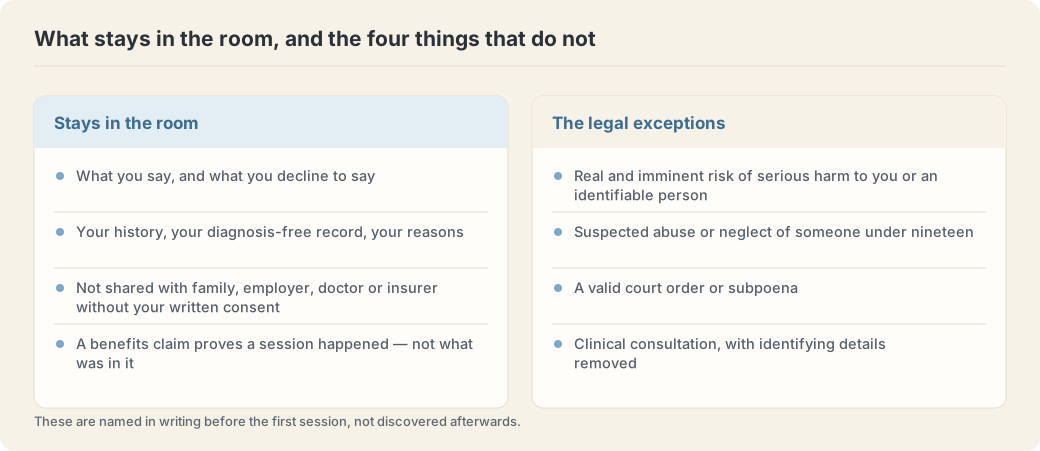
Who you would see
Taking new clients and seeing people across BC by secure video. Each is a Registered Clinical Counsellor; the registration is on the profile and can be checked on the BCACC register.

Camille Granda, RCC, CCC
English and Tagalog · Trauma, Anxiety and chronic stress, Grief, loss and life transitions
In her words: “I want sitting with me to feel like the biggest belly breath you have ever taken.”

Savneet Singh, RCC
English and Punjabi · Anxiety, Depression, Trauma and attachment
In her words: “Comforting, safe and supportive, is what I aim for.”
Where to start
The conversation with your siblings
The sibling problem is the most predictable feature of family caregiving and the one people most often try to solve by absorbing more. It rarely resolves on its own, and there is a version of the conversation that goes better than average.
Ask for specific tasks, not for help. "Can you take Tuesdays?" or "Can you handle the pharmacy and the insurance calls?" is answerable. "I need more support" invites sympathy and produces nothing, because it does not tell anyone what to do.
Write down what is actually being done, in hours, before the conversation. Siblings at a distance are frequently not being callous; they genuinely do not know, because the person doing it has never itemised it. The list is often startling to everyone including the person who wrote it.
Offer a menu. Money, time, logistics, respite weeks, taking over one system entirely. People contribute more when there is a way to contribute that fits their circumstances.
Expect the old roles to reassert themselves. Families under pressure revert to configurations set decades ago with remarkable precision. Knowing that in advance makes it less personal when it happens.
And decide in advance what you will do if the answer is no. Sometimes it is no. The realistic question then is not how to make them help but what you will change about your own commitment given that they will not, which is a harder question and the only one with an answer available to you.
After it ends
The period after caregiving ends is consistently harder than people anticipate, and almost nobody is warned about it.
Several things arrive at once. The structure disappears. Years of days organised around appointments, medications and someone else's needs, and then nothing, which is disorienting in a way that resembles the end of a career more than a bereavement.
The grief arrives properly, frequently for the first time. Caregiving is absorbing enough to defer it, and the deferral ends abruptly.
So does the relief, and it is the hardest thing to say to anyone. Relief that it is over, that the nights are yours again, that a long decline has stopped. It sits alongside grief rather than replacing it, and people conclude from it that they are monstrous.
And the exhaustion becomes visible. Years of deferred sleep, deferred health and deferred everything land at once, usually a few weeks in, and are frequently mistaken for depression when they are also the bill.
The other thing that arrives is a question with no obvious answer: who are you now. A role that consumed years and was never chosen has ended, and the life it displaced is not waiting where it was left.
This is one of the most common points at which caregivers seek counselling, long after everyone around them has assumed the difficult part is over, and it is a good reason rather than a late one.
Services that tend to fit
Individual therapy
The main container for load, grief, resentment and the decisions nobody else will make.
Depression counselling
When it has tipped from exhausting into flat, and the days have stopped varying.
Anxiety counselling
For the hypervigilance of waiting for the next phone call.
Couples therapy
When caring for one family has quietly cost another.
Counselling in Punjabi
For families where the obligation, and the conversation about it, happens in Punjabi.
Common questions
Is it selfish to get counselling for this?
No, and the question itself is the thing worth examining. Caregiver exhaustion degrades the quality of care as well as the carer, which is the practical answer; the fuller one is that your own life is not a resource to be spent down without comment.
Can my parent come to a session?
This work is about you rather than about them. Occasionally a joint session is useful, and that is a decision made together, but the default is that this is your hour.
What if the person I care for was not good to me?
Caring for someone who harmed you is its own specific and difficult situation, and it comes up more often than people expect. It is workable, and it does not require you to resolve the history first.
I might stop when it ends. Is that a bad idea?
The period after caregiving ends is frequently harder than people anticipate. The structure disappears, the grief arrives properly, and so does relief. It is worth planning for rather than being surprised by.
Sources and further support
General information, not clinical advice, and not a diagnosis. If you are in crisis, call or text 9-8-8 (Canada, 24/7) or BC Mental Health Support at 310-6789. In immediate danger, call 911.
Where you are
Online counselling across British Columbia
Every session is by secure video, so the counsellor you see does not depend on where you live. Each city page covers coverage, local public services and who is taking new clients there.
One conversation, no commitment.
A free 15-minute consultation over secure video, including an honest answer if something other than counselling would serve you better.
Book Free ConsultationNot ready to book? Send a line about what is going on. A reply comes within one business day, or read the guides first and come back when you want to.
Looking on behalf of someone else? What to send them, and what not to, including the funded routes most people do not know they qualify for.