BC resource
Does my student health plan cover counselling? BC student supports
Every public post-secondary institution in BC provides some counselling to enrolled students at no cost, usually short-term. Alongside that: Here2Talk offers free 24/7 single-session counselling to all BC post-secondary students, Foundry serves anyone aged 12 to 24, and many student societies carry a plan that may reimburse an RCC, depending on the plan; the plans checked on this page pay 70% to 100% of a session, with yearly maximums from $450 to $1,250. Most students qualify for at least three of these and know about one.
Students have more free support available than almost any other group in the province, and consistently under-use it because nobody explains what it covers.
7 min read · Updated
Start with what costs nothing
- Here2Talk, Free, confidential single-session counselling for students registered at a BC post-secondary institution, available 24/7 by phone, app or online chat. No referral, no waitlist, and it works from anywhere, including outside the province during a term break.
- Your campus counselling service, Every public institution in BC provides counselling to enrolled students at no cost. Typically short-term and typically faster than community services. Availability tightens sharply around midterms and finals, so booking early in a term is a genuine advantage.
- Foundry, for ages 12 to 24, Centres across BC plus a virtual service: free counselling, often with drop-in access, no referral needed. Serves young people whether or not they are in school, and supports caregivers too.
- 9-8-8 and 310-6789, Crisis and emotional support, 24 hours a day, free from anywhere in the province. Not only for the moment of highest risk.
- Kids Help Phone, Available by phone and text to young people across Canada, 24/7, including for people well into their twenties.
The student health plan almost nobody reads
Many student unions in British Columbia include an extended health and dental plan in student fees, and many of those plans reimburse counselling from registered practitioners up to an annual maximum; what yours pays depends on the plan. Students routinely pay for this in September and never use it. The table below shows what the main BC student-society plans pay, read from each plan's own page.
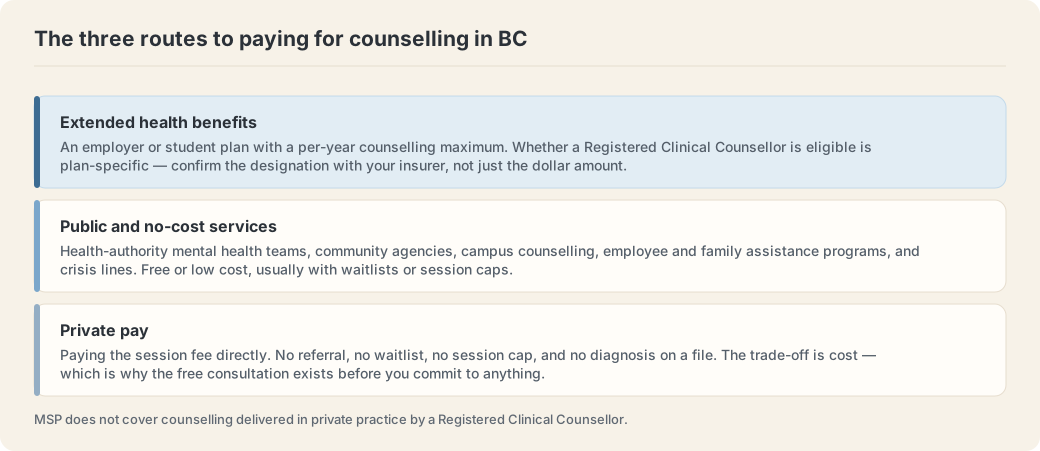
Two details determine whether it is useful to you. First, which designations the plan reimburses. Some cover a Registered Clinical Counsellor, some cover only a psychologist, some cover both at different rates. Second, the annual maximum and when it resets, which is often the plan year rather than the calendar year.
These plans usually also have an opt-out window early in the term for students with equivalent coverage elsewhere, such as a parent's plan. Opting out of a plan you would have used is a common and avoidable mistake, check the counselling benefit before deciding.
Where you do have private coverage, extended health coverage in BC sets out how reimbursement works in practice.
| Plan | Pays | Yearly maximum | Sessions at $140 | Names the RCC? | Referral | Source |
|---|---|---|---|---|---|---|
| UBC AMS/GSS University of British Columbia (Vancouver) | 100% of each visit | $1,250 | 8 | Yes | Not stated on the plan page | Plan page read 1 October 2026 |
| SFSS Enhanced Simon Fraser University | 90% of each visit | $750 | 5 | Yes | Not stated on the plan page | Plan page read 1 October 2026 |
| SFSS Basic Simon Fraser University | $30 of each visit | $650 | 21 | Yes | Not stated on the plan page | Plan page read 1 October 2026 |
| UVSS University of Victoria | 70% of each visit | $800 | 8 | Yes | None stated for mental-health practitioners | Plan page read 1 October 2026 |
| Langara Students’ Union Langara College | 100% of each visit | $500 | 3 | Yes | Not stated on the plan page | Plan page read 1 October 2026 |
| Kwantlen Student Association Kwantlen Polytechnic University | 80% of each visit | $500 | 4 | Yes | Not stated on the plan page | Plan page read 1 October 2026 |
| Douglas Students’ Union Douglas College | 80% of each visit | $450 | 4 | Says “counsellor”; ask | Not stated on the plan page | Plan page read 1 October 2026 |
Read from each plan’s own page on 1 October 2026. The yearly maximum is shared with psychologists and social workers, so anything already claimed this year comes off it. The sessions column is the maximum divided by what the plan pays back on one $140 individual session. Plans change each policy year and coverage is whatever your plan’s booklet says; check it before the first session. You pay at booking and claim the receipt; the practice does not bill the plan.
Where campus counselling runs out
Campus services are designed for short-term work, and they are good at it, an acute period, a specific crisis, a decision, adjusting to a first year away from home. For a bounded difficulty, a handful of sessions often does the job.
The limits show up in three places. Session caps mean long-standing patterns and trauma work rarely fit. Demand peaks exactly when students most need it, which is the fortnight before finals. And continuity is difficult across terms, summers and co-op placements, students frequently change counsellor mid-course because of the calendar.
That is not a criticism of a service doing what it was designed to do. It is a reason to know in advance where the ceiling is, and to ask at the first appointment what happens when you reach it.
Academic accommodation is a separate route
Every public post-secondary institution in BC has an accessibility or accessible-learning office, and mental-health conditions can qualify for academic accommodation: extended deadlines, alternative exam arrangements, reduced course load without losing full-time status for funding purposes, and in some cases retroactive withdrawal from a failed term.
This is a distinct process from counselling, with its own documentation requirements, and it is worth starting before a term goes wrong rather than after. Documentation usually has to come from a physician or psychologist rather than a counsellor, because accommodation processes typically require a diagnosis, and a Registered Clinical Counsellor does not diagnose.
Students on StudentAid BC should also check the implications of a reduced course load for funding before reducing it, because the two systems do not always align automatically.
For secondary students and their families
- School counsellors, Every BC school district provides counselling in schools. Availability and caseload vary considerably by district, and the role often covers course planning alongside personal support.
- Child and youth mental health teams, Provincial services offering free assessment and treatment for those under 19, with intake offices across BC. Self-referral is accepted in most regions. A doctor's referral is generally not required.
- Foundry, From age 12, including drop-in at physical centres and a virtual service across the province.
- Kelty Mental Health Resource Centre, Provincial resource centre for children, youth and families, information, navigation help and peer support from parents who have used the system.
- Support for caregivers, Parents can access support in their own right rather than only as a route to their child. Foundry and Kelty both work with caregivers directly.
When private counselling makes sense for a student
Private counselling is worth considering when campus sessions have run out mid-course, when you need a specific approach the campus service does not offer, when continuity across terms matters, or when your student health plan covers a meaningful share of the fee anyway.
It is also worth it when the difficulty is not about school. Family, relationships, trauma and identity do not respect a semester structure, and a service organised around one is not always the right container.
The practical constraints are real, though. Student budgets are tight, and a plan built without reference to the money tends to end abruptly. Being direct about what you can sustain is a normal conversation, see weekly vs biweekly sessions and low-cost counselling in BC.
Timing it around the academic year
Campus services are subject to a demand curve so predictable that planning around it is worth real time saved.
September and January are the quietest, and the easiest points to be seen quickly. Booking early in a term, even for something that does not feel urgent yet, is the single most effective piece of scheduling available to a student.
Mid-October to November and mid-March to April are the peak, for the obvious reason. Waits lengthen sharply, and the students who most need to be seen are frequently the ones who cannot face booking.
Reading break is underused. Services generally continue running while demand drops.
Summer is complicated. Some institutions reduce counselling over the summer, and some students lose eligibility if not enrolled. Worth checking in April rather than in July, particularly if you are on a co-op term.
Two further timing points that catch people out. Student health plan coverage typically runs on a plan year rather than a calendar year, and unused benefit does not carry over, so an unused counselling allowance disappears. And academic accommodation requests take time to process, which means starting the conversation before a term goes wrong is worth far more than a retroactive appeal afterwards.
The specific pressures that bring students in
- The first term away from home, A larger transition than it is credited as being, every routine, relationship and support structure replaced at once, alongside academic demands. The dip in October and November is common enough to be predictable.
- Achievement as identity, For students whose sense of self is built on academic performance, a first bad grade is not a setback but a threat to who they are. Common in high-achieving students and in first-generation students carrying a family's expectations.
- International student isolation, Language, distance, visa constraints, financial pressure, and a family whose expectations were formed at a distance from the reality. A specific and heavy combination.
- Sleep destroyed by design, Late schedules, irregular timetables, caffeine, and a culture that treats not sleeping as commitment. Sleep loss then degrades exactly the capacities being assessed.
- The comparison problem, Constant visibility of peers who appear to be coping better, which is a comparison of your inside to everyone else's outside, conducted continuously.
- Deciding whether to continue, A legitimate and enormous question, frequently entangled with family expectation, sunk cost and debt, and one that people try to answer alone.
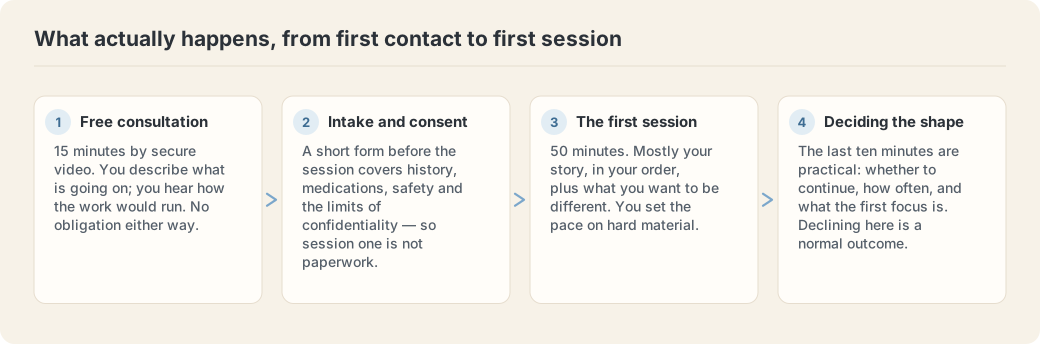
Student counselling in BC: the short version
Every post-secondary student in BC has two guaranteed layers before money enters the picture: campus counselling, funded by fees at every major institution, and Here2Talk, the provincial 24/7 single-session service, free by app, phone or chat for all registered students. High-school students have school counsellors and, for ages 12–24, the Foundry network. None of these require a diagnosis, a referral, or a parent’s involvement for adults.
The honest limits: campus services are short-term models with late-semester waits, and Here2Talk is single-session by design. When a student needs ongoing weekly work, the usual route is private counselling reimbursed through the student union’s extended-health plan. Many plans cover Registered Clinical Counsellors, depending on the plan, and the annual cap decides how many sessions it funds. Therapists for students, in other words, exist at every price point including zero; the sections below map who qualifies for what.
Common questions
Will my university know I used campus counselling?
Counselling records are confidential and separate from academic records. Faculty are not informed. The exceptions are the same legal ones that apply to any counselling: risk of serious harm to you or someone else, a child or vulnerable adult at risk of abuse or neglect, or a court order.
Can I use campus counselling and a private counsellor at the same time?
Generally yes. Tell both so that neither is working blind and the work is coordinated rather than duplicated.
Does my student health plan cover a Registered Clinical Counsellor?
Many do, and some cover only a psychologist. Check your specific plan booklet for the designation, not just the dollar amount. It is the detail that most often trips people up.
I am an international student. Do these apply to me?
Here2Talk and campus counselling are generally available to all enrolled students regardless of status. Health plan coverage varies: the insurance an institution arranges for the months before MSP is a separate policy from the student society's extended health plan, and it is usually the society plan that reimburses counselling. Check which one you are claiming on.
Should I claim on my own student plan or a parent's plan?
Your own student plan first, then send what it did not pay to the parent's plan. A claim on a parent's plan appears in the parent's claim history; a claim on your own plan goes to you.
Does the UBC AMS/GSS plan cover a Registered Clinical Counsellor?
Yes, by name. The UBC AMS/GSS plan (University of British Columbia (Vancouver)) pays 100% of each visit with a Registered Clinical Counsellor, up to $1,250 a policy year, shared with psychologists and social workers. Referral: not stated on the plan page. Read from the plan’s own page on 1 October 2026; the booklet for your year is the authority.
Does the SFSS Enhanced plan cover a Registered Clinical Counsellor?
Yes, by name. The SFSS Enhanced plan (Simon Fraser University) pays 90% of each visit with a Registered Clinical Counsellor, up to $750 a policy year, shared with psychologists and social workers. Referral: not stated on the plan page. Read from the plan’s own page on 1 October 2026; the booklet for your year is the authority.
Does the SFSS Basic plan cover a Registered Clinical Counsellor?
Yes, by name. The SFSS Basic plan (Simon Fraser University) pays $30 of each visit with a Registered Clinical Counsellor, up to $650 a policy year, shared with psychologists and social workers. Referral: not stated on the plan page. Read from the plan’s own page on 1 October 2026; the booklet for your year is the authority.
Does the UVSS plan cover a Registered Clinical Counsellor?
Yes, by name. The UVSS plan (University of Victoria) pays 70% of each visit with a Registered Clinical Counsellor, up to $800 a policy year, shared with psychologists and social workers. Referral: none stated for mental-health practitioners. Read from the plan’s own page on 1 October 2026; the booklet for your year is the authority.
Does the Langara Students’ Union plan cover a Registered Clinical Counsellor?
Yes, by name. The Langara Students’ Union plan (Langara College) pays 100% of each visit with a Registered Clinical Counsellor, up to $500 a policy year, shared with psychologists and social workers. Referral: not stated on the plan page. Read from the plan’s own page on 1 October 2026; the booklet for your year is the authority.
Does the Kwantlen Student Association plan cover a Registered Clinical Counsellor?
Yes, by name. The Kwantlen Student Association plan (Kwantlen Polytechnic University) pays 80% of each visit with a Registered Clinical Counsellor, up to $500 a policy year, shared with psychologists and social workers. Referral: not stated on the plan page. Read from the plan’s own page on 1 October 2026; the booklet for your year is the authority.
Does the Douglas Students’ Union plan cover a Registered Clinical Counsellor?
The Douglas Students’ Union plan (Douglas College) pays 80% of each visit for a counsellor, psychologist or social worker, up to $450 a policy year, but its page says “counsellor” without naming the Registered Clinical Counsellor. Ask the plan before the first session whether an RCC qualifies. Read on 1 October 2026.
Using this page
- Free to link to, from any website, intranet, handout or resource list. No need to ask.
- May be reproduced, in print or online, with attribution to Westpeak Wellness and a link to this page.
- Last updated October 1, 2026.
- Spotted something out of date? Email info@westpeakwellness.com.
Suggested citation
Sources
General information, not clinical, financial, or legal advice. Coverage and service details change, verify anything decision-critical directly with the provider or insurer. If you are in crisis, call or text 9-8-8 (Canada, 24/7) or 310-6789 for BC Mental Health Support.