Guide · Online counselling
Is online therapy as effective as in-person therapy?
For the concerns most people bring to counselling: anxiety, depression, trauma, relationship difficulty, the research consistently finds video-delivered therapy produces outcomes broadly comparable to in-person work. That is not the same as saying the two are identical, and the differences are worth understanding before you decide.
It is the most common question people ask before booking a virtual session, and it deserves a real answer rather than reassurance.
6 min read · Updated
What the research actually shows
Video-delivered psychotherapy has been studied seriously for about two decades, and the picture that has emerged is unusually consistent for mental-health research. A 2021 meta-analysis in Clinical Psychology Review pooling videoconferenced mental and behavioural health services against in-person delivery found broadly equivalent outcomes. Systematic reviews of videoconference-delivered CBT for adults have reached similar conclusions.
The evidence is strongest for the conditions counselling most often addresses: depression, generalized anxiety, panic, and social anxiety. For post-traumatic stress there is an established base showing structured protocols: prolonged exposure, cognitive processing therapy, behavioural activation, delivered by video performing comparably to the same protocols delivered in a room.
An important limit on all of this: "broadly comparable on average, across studies" is a statement about groups, not about you. Research describes what tends to happen across many people. It cannot tell you whether video will suit how you think, what you are bringing, or how you form trust. That question gets answered in the first couple of sessions, not in a meta-analysis.
The therapeutic relationship, the part people worry about most
The usual objection is not about technique. It is that something essential in the relationship gets lost through a screen. That worry is reasonable, because the working relationship between client and counsellor is one of the better predictors of whether therapy helps at all.
The evidence here is more mixed than the outcome evidence. A 2024 systematic review and meta-analysis in the Journal of Telemedicine and Telecare examining therapeutic alliance in videoconferencing versus in-person psychotherapy found alliance generally comparable, while noting genuine inconsistency across studies. The honest summary is: most people build a working relationship over video about as well as they do in a room, and some people do not.
Where video is genuinely harder
A page that only lists advantages is selling something. These are the real trade-offs:
- Eye contact does not quite work, Cameras sit above screens, so nobody is ever quite looking at anybody. Most people stop noticing within a session or two, but it is a real difference.
- Some non-verbal information is lost, A screen frames head and shoulders. Posture shifts, hand movement, and the way someone holds their whole body are partly cut off.
- Technology interrupts, A frozen frame in the middle of a difficult sentence breaks something that a quiet room would have held. Agreeing in advance what happens if the call drops takes thirty seconds and removes most of this.
- Home is not always a containing space, For some people the therapist's office is useful precisely because it is separate. You go there, you do the work, you leave it behind. Doing trauma work in the room where you also sleep is a different experience, and not always a better one.
- Privacy can be the hard part, Thin walls, roommates, small apartments, a partner working from home. This is the most common practical barrier, and it is worth solving before the first session rather than during it.
- Some situations need in-person care, Acute risk, some assessments, and circumstances requiring in-person medical involvement are not well served by video. A responsible counsellor will say so and help you find the right referral.
What makes video sessions work better
The difference between a frustrating virtual session and a good one is usually logistics rather than anything clinical:
Use headphones. They improve audio and privacy at once. Find a door that closes, even if it is a parked car outside the house. Test the connection before the first session rather than during it. Put the device on something solid at roughly eye level. And agree with your counsellor at the outset what you will both do if the call fails mid-session, so that a dropped connection is an inconvenience rather than an abandonment.
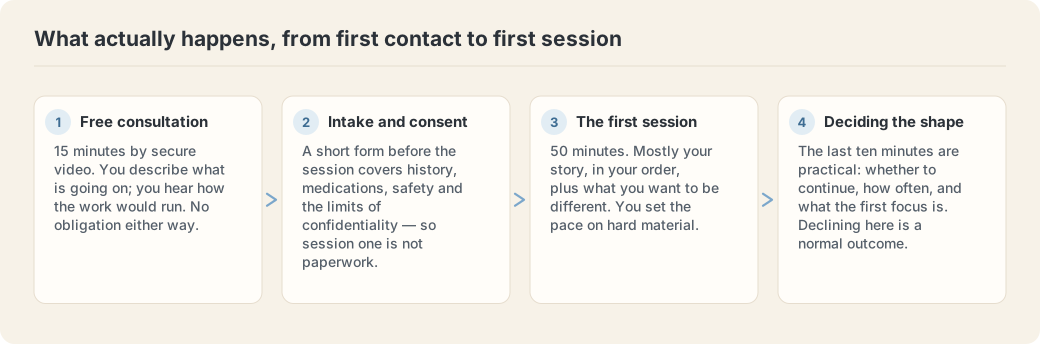
The most reliable way to find out whether video suits you is to try fifteen minutes of it at no cost. Book a free 15-minute consultation.
What this means in British Columbia specifically
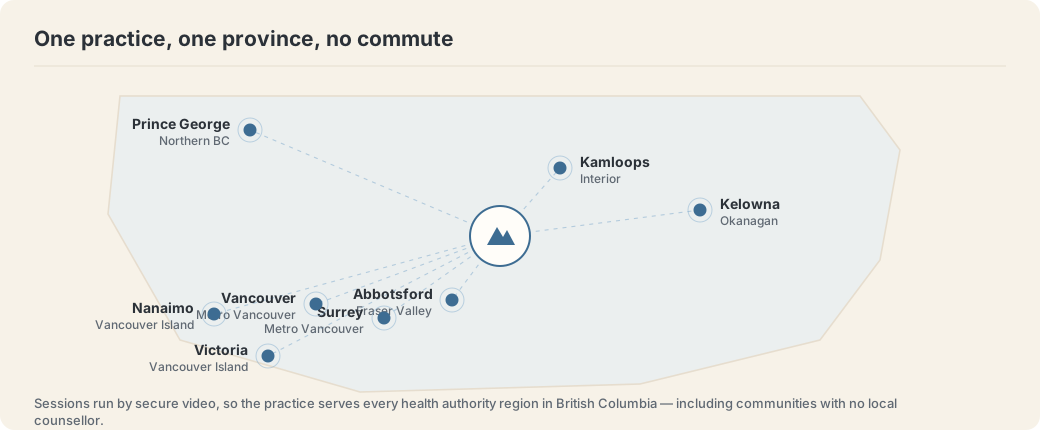
In BC the argument for virtual counselling is not mainly about convenience. It is about access. Counsellors cluster in the Lower Mainland and the southern Island. If you live in the north or the Interior, the realistic local choice may be a short list with waitlists rather than a genuine choice at all; the practical reality of that is set out on the Prince George page.
It matters even more if you need therapy in a language other than English. Availability of counsellors who work in a given language varies, and BCACC’s Find a Counsellor directory filters by language; by video, therapy in Punjabi works the same anywhere in the province.
On cost: BC's Medical Services Plan does not cover counselling, whatever the format. Extended health plans that cover Registered Clinical Counsellors generally treat a virtual session exactly as they treat an in-person one. The fees and coverage page sets out how reimbursement works.
Who video suits least well
The averages in the research conceal real variation, and it is worth knowing in advance which side of it you might sit on. Video suits people with a stable private space, a reliable connection, and enough comfort with the format that the technology stops being noticeable within a session or two. That describes most people, which is why the pooled results look the way they do.
It suits some situations considerably less. Where someone is at meaningful risk and might need a physical response, a scheduled video appointment is a poor container. That is a crisis service or an in-person team, and it is the clearest limitation of the format. Where a client dissociates heavily, the loss of a shared physical room removes cues that help re-orient someone, and a counsellor has fewer options for helping them come back.
It also suits less well where there is nowhere private. A session conducted with one ear on the corridor is not a session, and this is the single most common practical reason virtual work fails. It has nothing to do with technology and everything to do with housing.
Finally, some people find the screen an obstacle they do not stop noticing. There is no way to predict that in advance, and two or three sessions is usually enough to know. Deciding it is not for you is a legitimate finding rather than a failure of effort.
What to check before your first video session
- Where you will actually sit, A door that closes matters more than a good camera. Work this out before the appointment rather than five minutes into it, a bedroom, a parked car, or a booked meeting room all work.
- Headphones, The single highest-value item. They keep the counsellor's side of the conversation from being audible in the next room, which changes how freely you speak more than anything else on this list.
- A backup plan, Agree in advance what happens if the connection drops, usually rejoining the same link, or moving to the next slot. Knowing this removes a background anxiety that otherwise occupies part of every session.
- Whether you want to see yourself, Most platforms let you hide your own video while remaining visible. A surprising number of people find self-view distracting, and turning it off is worth trying early.
- Ten minutes afterwards, The commute home from an in-person session did something useful: it created a transition. Scheduling ten unclaimed minutes after a video session replaces it, and going straight from a hard session into a meeting is worth avoiding.
What changed after 2020, and what it means for the evidence
A large share of the research on video-delivered therapy predates the period when practically every clinician in the world was forced to deliver it. That matters in two directions and it is worth being precise about both.
Before 2020, the people doing video therapy were largely self-selected on both sides, clinicians who chose the format and clients comfortable with it. That is a real limitation on generalising the early findings, because the study populations were not typical.
After 2020, the sample became everybody. Clinicians who disliked the format used it anyway; clients with no interest in it had no alternative. The outcome data from that period is therefore drawn from a far less selected population, and it has broadly held up rather than collapsing, which strengthens the earlier conclusions rather than undermining them.
What also emerged was a clearer picture of who it fits badly, because for the first time the format was applied to people who would never have chosen it. That is where the specific limitations came from: severe risk needing physical response, significant dissociation, and the absence of private space. Those are now understood as real constraints rather than as generic scepticism about screens.
The honest summary is that the evidence base is better than it was, more representative than it was, and still describes averages across groups. It cannot tell you whether this will suit you, and two or three sessions can.
Common questions
Does online therapy work for trauma and EMDR?
There is an established evidence base for structured trauma protocols delivered by video, and EMDR adapts to virtual sessions using on-screen or self-administered bilateral stimulation. Pacing matters more than format, safety and stability come first either way. You can read more on the EMDR therapy page.
Is a virtual session as confidential as an in-person one?
From the counsellor's side, yes. The same professional obligations and BC privacy law apply, and sessions run on a secure platform rather than ordinary consumer video calling. The variable is your side of the call: a private space and headphones do most of the work.
Will my extended health plan cover a video session?
Plans that list an RCC usually reimburse a video session on the same terms as in person, but this depends on the plan. Ask: are virtual sessions with an RCC eligible, and on the same maximum?
What if I try it and it does not suit me?
That is a legitimate outcome and worth saying out loud early. Some people work better in a room, and a counsellor who cannot offer that should help you find someone who can.
Sources
- Are videoconferenced mental and behavioral health services just as good as in-person? A meta-analysis, Clinical Psychology Review (2021)
- Effectiveness of videoconference-delivered CBT for adults with psychiatric disorders, systematic and meta-analytic review
- Therapeutic alliance in videoconferencing psychotherapy compared to in person, Journal of Telemedicine and Telecare (2024)
- HereToHelp BC, mental health information for British Columbians
This guide is general information, not clinical advice, and it cannot diagnose anything or replace an assessment. If you are in crisis, call or text 9-8-8 (Canada, 24/7) or BC Mental Health Support at 310-6789.
Who you would talk to
Taking new clients and seeing people across BC by secure video. Each is a Registered Clinical Counsellor; the registration is on the profile and can be checked on the BCACC register.

Camille Granda, RCC, CCC
English and Tagalog · Trauma, Anxiety and chronic stress, Grief, loss and life transitions
In her words: “I want sitting with me to feel like the biggest belly breath you have ever taken.”

Savneet Singh, RCC
English and Punjabi · Anxiety, Depression, Trauma and attachment
In her words: “Comforting, safe and supportive, is what I aim for.”
Individual sessions are $140 for 50 minutes, after a free 15-minute consultation; card at booking.
Many extended health plans reimburse a Registered Clinical Counsellor, depending on the plan, so check yours; MSP does not cover private counselling. All fees.
Still deciding?
A free 15-minute consultation is the least committal way to find out whether this is a fit. No pressure, and no obligation to book a session afterward.
Book Free ConsultationNot ready to book? Send a line about what is going on. A reply comes within one business day.
Or a smaller step: What sessions cost · What the free 15 minutes is like
Looking on behalf of someone else? What to send them, and what not to, including the funded routes most people do not know they qualify for.
Keep going
More counselling guides
Where you are
Online counselling across British Columbia
Every session is by secure video, so the counsellor you see does not depend on where you live. Each city page covers coverage, local public services and who is taking new clients there.