Approach · CBT
Cognitive behavioural therapy (CBT)
CBT is a structured, present-focused, time-limited therapy built on the observation that thoughts, feelings and behaviour hold each other in place. It has the largest evidence base of any psychological treatment, particularly for anxiety and depression. Its defining features are an agreed target, work between sessions, and a measurable idea of progress. A course of open-ended conversation is not CBT, whatever it is called.
The most researched talk therapy there is, and the one most often delivered badly, because the structure is what makes it work.
7 min read · Updated
What actually happens in a course of CBT
CBT is unusual among therapies in having a recognisable shape, and knowing it lets you tell whether you are receiving it.
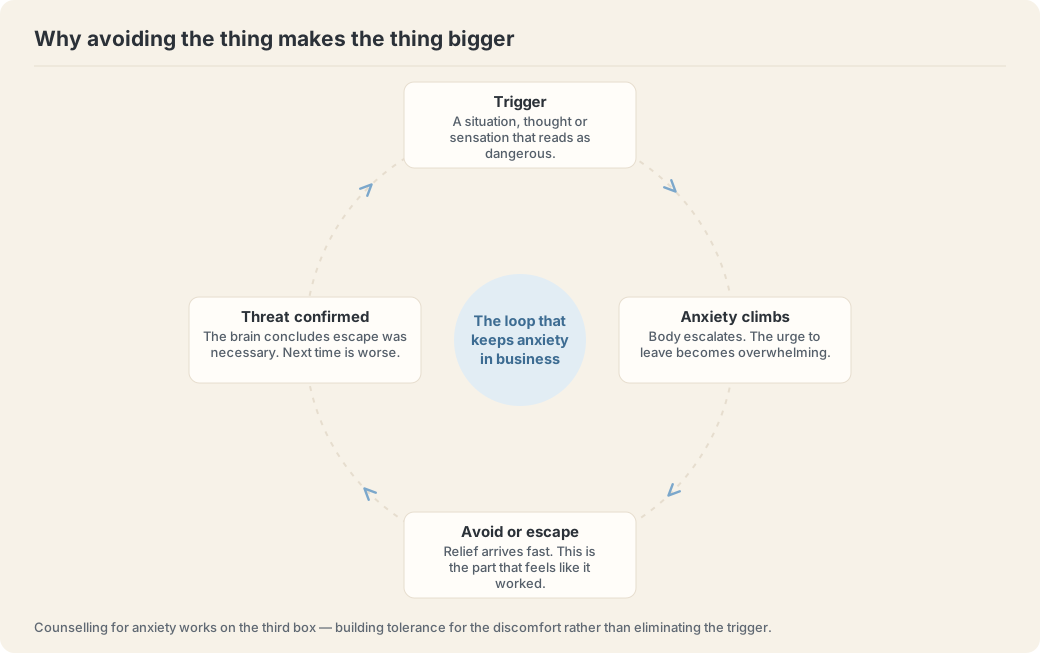
Sessions one to three: formulation. Rather than a general history, the work builds a specific map of how the difficulty is maintained now. The situations that trigger it, the thoughts that arrive, the feelings, the physical response, and crucially what you do next. That last element is usually where the maintaining mechanism sits.
Then an agreed target and a measure. Not "feel better" but something checkable, and frequently a short questionnaire repeated across the course so that change is measured rather than recalled. Being asked to complete the same eight questions each week is a sign of the method being applied properly, not of box-ticking.
Then the intervention phase, which varies by problem. Behavioural experiments to test a specific prediction. Graded exposure for anxiety. Activity scheduling for depression. Thought records to catch and examine automatic interpretations. Each session typically opens with a review of the between-session work and closes by agreeing the next piece.
Then relapse prevention. Explicitly identifying your own early warning signs and writing a plan for what to do if the pattern returns. This is a defined stage rather than an afterthought, and skipping it is one of the more common ways gains fail to hold.
What the evidence supports it for
CBT has been studied more than any other psychological treatment, and the evidence is strongest and most consistent for the anxiety disorders and for depression. Specific protocols exist for panic, social anxiety, generalised anxiety, health anxiety, obsessive-compulsive presentations and insomnia, and the disorder-specific versions generally outperform generic CBT.
That last point matters practically. "CBT for anxiety" is not one thing. The protocol for panic works on the fear of bodily sensations, while the protocol for generalised anxiety works on the process of worry and on intolerance of uncertainty. Applying the wrong one is a common reason people conclude CBT did not work for them.
For insomnia specifically, CBT-I is recommended ahead of medication in most major clinical guidelines and is considerably less known than it should be, see anxiety and sleep.
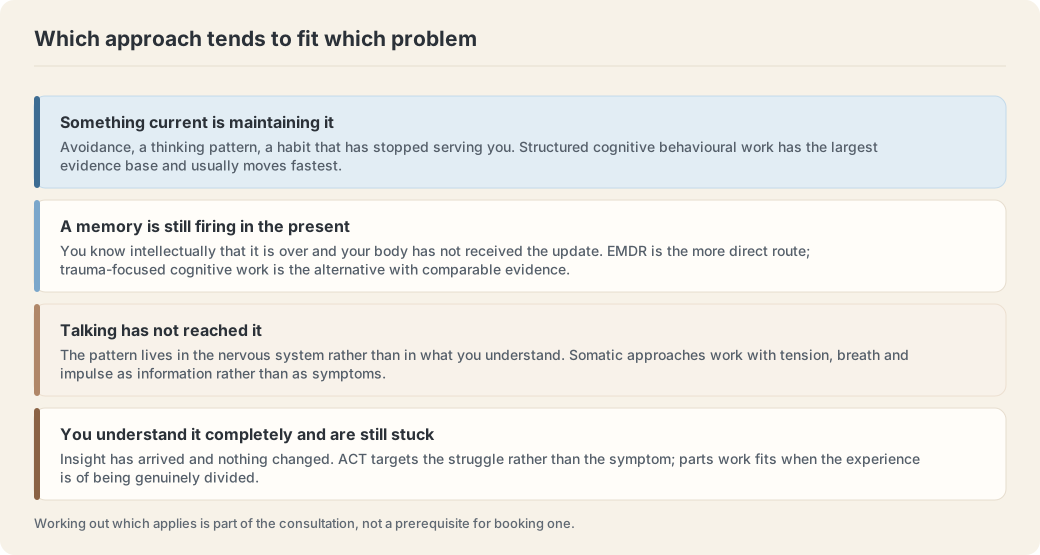
Where the evidence is thinner is for long-standing relational patterns, complex trauma and personality-level difficulties. CBT can contribute there, and it is generally not the whole answer, which is why practitioners trained only in it will sometimes tell you honestly that you need something else.
If a structured, targeted piece of work is what you are after, a free 15-minute consultation can establish whether it fits.
Where it works poorly
- When there is no defined target, CBT depends on knowing what you are working on. For someone who cannot yet say what the difficulty is, an exploratory phase has to come first, and calling that phase CBT is a misnomer.
- When the between-session work does not happen, Most of the change occurs in the other 167 hours. Where circumstances make that impossible, a crisis, an unstable situation, no capacity. The method loses much of its power and should be adapted rather than repeated.
- When the problem is happening now, CBT cannot resolve an ongoing stressor. Where the situation is unsafe or unchanged, examining your thinking about it can shade into implying the problem is your interpretation, which is both untrue and harmful.
- When the difficulty is relational and old, Patterns formed early and rehearsed for decades usually need something that works on the relationship itself, including the one in the room.
- When it is delivered as advice, Badly done CBT becomes a counsellor telling you your thoughts are irrational. Done properly it is collaborative testing, and you reach the conclusions.
How to tell it is being done properly
A few markers separate structured CBT from a conversation with CBT vocabulary attached.
There is an explicit shared formulation. A diagram or written map of how your difficulty is maintained, which you helped build and which gets revised. There is an agenda at the start of each session, agreed between you. There is between-session work, negotiated rather than assigned, and it is reviewed at the next session rather than quietly dropped. There is a measure repeated over time. And there is a stated endpoint rather than an open horizon.
If none of those is present after four or five sessions, it is fair to ask directly what approach is being used and how progress will be judged, see questions worth asking a therapist.
The other honest marker: good CBT is more uncomfortable than people expect, because the active ingredient is usually doing the thing you have been avoiding, in graded steps, rather than understanding why you avoid it.
Common questions
Is CBT just positive thinking?
No, and practitioners find the comparison frustrating. CBT tests the accuracy of interpretations rather than replacing them with cheerful ones, and a thought that turns out to be accurate is addressed behaviourally instead.
How many sessions does CBT take?
Protocols are typically designed around 8 to 20 sessions depending on the presentation. Long-standing or multiple difficulties take longer, see how long therapy takes.
Do I have to do homework?
Between-session practice is where most of the change happens, so effectively yes. It is negotiated rather than imposed, and it should be small enough to actually do.
Can CBT be done by video?
Yes. It is among the approaches with the strongest evidence for video delivery, partly because its structure transfers cleanly to a screen.
Sources
- Anxiety Canada
- HealthLink BC, mental health and substance use
- Canadian Mental Health Association, BC Division
This guide is general information, not clinical advice, and it cannot diagnose anything or replace an assessment. If you are in crisis, call or text 9-8-8 (Canada, 24/7) or BC Mental Health Support at 310-6789.
Where you are
Online counselling across British Columbia
Every session is by secure video, so the counsellor you see does not depend on where you live. Each city page covers coverage, local public services and who is taking new clients there.
Still deciding?
A free 15-minute consultation is the least committal way to find out whether this is a fit. No pressure, and no obligation to book a session afterward.
Book Free ConsultationNot ready to book? Send a line about what is going on. A reply comes within one business day, or read the guides first and come back when you want to.
Looking on behalf of someone else? What to send them, and what not to, including the funded routes most people do not know they qualify for.