Approach · Somatic
Somatic and body-based approaches
Somatic approaches treat the body as a source of information rather than a passenger: tracking tension, breath, posture and impulse as part of the work. They are used most in trauma treatment, where the nervous system holds a pattern that understanding alone does not reach. They are best regarded as a way of working rather than a single protocol, and the quality of the practitioner matters more here than in more manualised methods.
Because you can know with complete certainty that you are safe and still have a body that has not received the update.
7 min read · Updated
Why the body is involved at all
The rationale is straightforward once stated. A threat response is a whole-body event: heart rate, muscle tension, breathing, digestion, posture, the impulse to fight, flee or freeze. When that response completes, the system returns to baseline. When it does not, elements of it can persist long after the situation has passed.
That is why someone can understand perfectly well that a past event is over and still find their shoulders up around their ears, their sleep broken, and their body braced in a room where nothing is happening. Insight operates on one system; the pattern is running in another.
It is also why purely verbal approaches sometimes stall on trauma. Talking about an event can be useful, and it does not necessarily reach a nervous system that is not primarily linguistic.
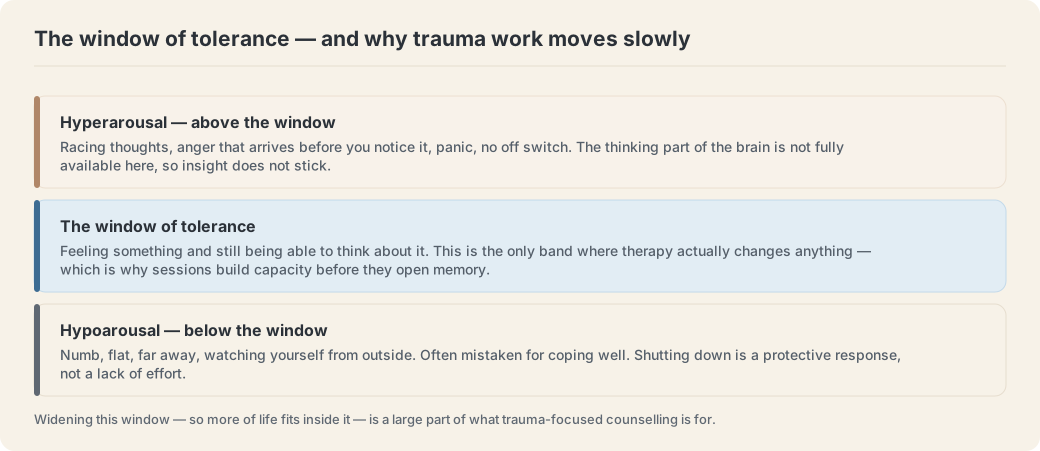
The window of tolerance is the working concept: the band of arousal in which you can feel something and still think about it. Somatic work is largely about noticing where you are in relation to that band, and building the capacity to come back into it deliberately.
What sessions actually involve
People frequently expect either massage or something mystical. It is neither, and in a virtual practice it involves no physical contact at all.
Practically, sessions involve tracking, noticing what is happening in the body as you talk, and naming it. Where the tightness is. What happens to your breath when a particular subject arrives. Whether an impulse appears, to move, to push away, to curl up.
Titration is the other core idea: approaching difficult material in small amounts rather than all at once, and returning to something settled in between. This is a deliberate pacing strategy rather than caution for its own sake, and it is what allows difficult material to be approached without flooding.
Resourcing builds the other half: deliberately establishing what settles your system, in the body rather than in theory, and practising reaching for it when calm so it is available when not.
Sessions tend to be slower than talking therapy and to contain more silence. For people who arrive wanting to analyse, that pace can be frustrating at first; for people who have analysed extensively and got nowhere, it is frequently the point.
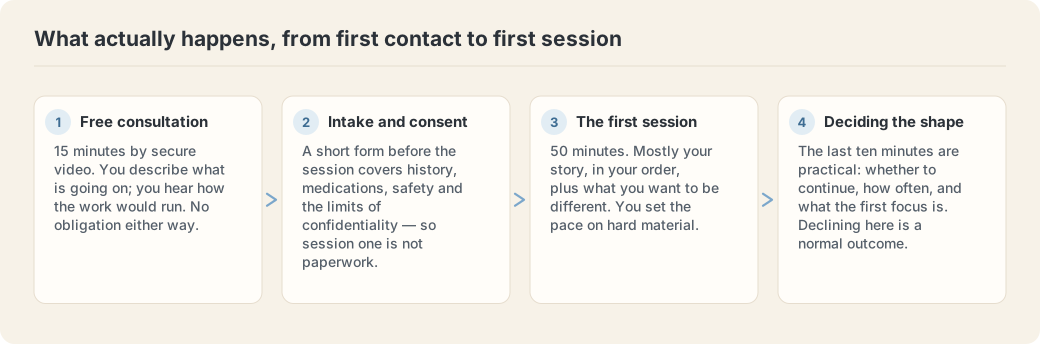
If you understand what happened and your body has not caught up, a free 15-minute consultation is a reasonable next step.
Doing it by video
Body-based work by video is more workable than people assume, with two genuine caveats.
What transfers well: tracking, breath work, orienting to the room, grounding, titration, and building a repertoire of things that reliably shift your state. All of that is verbal instruction and your own attention, and none of it requires the practitioner to be in the room.
What does not transfer: anything involving touch, and some of the finer observation a practitioner would make of whole-body posture and micro-movement. A camera shows a head and shoulders. A careful clinician compensates by asking more rather than assuming, which is arguably better practice anyway.
The caveat that matters more is safety. Where someone dissociates heavily, the shared physical room provides cues that help re-orient them, and losing those is a real limitation. That is a reason for careful assessment before starting rather than a blanket exclusion, and it is exactly the kind of thing a consultation should establish.
Choosing a practitioner carefully
"Somatic" describes a family of approaches rather than a single credential, and the range of training behind the word is wider than in most methods. That makes the usual questions more important rather than less.
Ask what specific training they have completed and with which body. Several established somatic trainings exist and involve substantial supervised hours; a weekend workshop also exists. Both may be described the same way on a website.
Ask how they handle dissociation and what they do if someone destabilises. A careful practitioner has a clear answer involving pacing and stabilisation rather than confidence.
Ask whether their scope includes touch, and if so, how consent is handled. In a virtual practice this does not arise; in person it is a question worth asking directly.
And be cautious of claims that the body "stores" specific memories in specific places, or that a particular technique releases trauma held in an organ. These are popular framings that outrun the evidence, and a practitioner making them confidently is telling you something about how they weigh claims. See how to verify a counsellor in BC.
Common questions
Does somatic therapy involve touch?
Some in-person modalities do. This is a fully virtual practice, so no session here involves physical contact. The work is verbal instruction and your own attention.
Is it evidence-based?
Body-based principles are integrated into several well-evidenced trauma treatments. Specific branded somatic modalities vary considerably in how much research supports them, and it is fair to ask a practitioner directly.
Do I need to be good at noticing my body?
No. Difficulty noticing is common, particularly with a trauma history, and building that capacity is part of the work rather than a prerequisite.
Is this the same as yoga or breathwork?
No. Those can be helpful and are not clinical treatment. Somatic therapy is delivered by a registered clinician within a therapeutic frame with defined limits.
Sources
- HealthLink BC, mental health and substance use
- Canadian Mental Health Association, BC Division
- BC Association of Clinical Counsellors
This guide is general information, not clinical advice, and it cannot diagnose anything or replace an assessment. If you are in crisis, call or text 9-8-8 (Canada, 24/7) or BC Mental Health Support at 310-6789.
Keep reading
Related pages
Where you are
Online counselling across British Columbia
Every session is by secure video, so the counsellor you see does not depend on where you live. Each city page covers coverage, local public services and who is taking new clients there.
Still deciding?
A free 15-minute consultation is the least committal way to find out whether this is a fit. No pressure, and no obligation to book a session afterward.
Book Free ConsultationNot ready to book? Send a line about what is going on. A reply comes within one business day, or read the guides first and come back when you want to.
Looking on behalf of someone else? What to send them, and what not to, including the funded routes most people do not know they qualify for.