Approach · IFS
Internal Family Systems and parts work
Internal Family Systems treats the mind as made up of parts, each with a protective intention however unhelpful its strategy. The part that wants to leave the job, and the part that is terrified of leaving. The work involves getting to know those parts rather than overruling them. Its clinical following is large; its research base is younger and thinner than CBT's, and an honest account says so.
For the experience of genuinely wanting two opposite things and being unable to reconcile them.
7 min read · Updated
The core idea
The starting observation is ordinary: people routinely describe themselves in plural terms. "Part of me wants to leave." "There is a bit of me that sabotages this." "I do not know why I do that. It is not me."
IFS takes that language seriously rather than treating it as a figure of speech. It proposes that the mind naturally operates as a system of parts, and that these parts take on roles, often in response to something difficult, and continue playing them long after the circumstances have changed.
The model distinguishes broadly between protectors, which work to prevent pain, and exiles, which carry it. Protectors come in two flavours: the managerial kind that tries to prevent problems in advance (the perfectionist, the people-pleaser, the one who over-prepares), and the reactive kind that intervenes when something breaks through (the one that drinks, rages, or shuts down).
The crucial move is that no part is treated as the enemy. A part behaving destructively is understood as protecting something, badly, with the only strategy it has. That reframing is what people most often describe as the useful thing, self-criticism becomes considerably harder to sustain toward a part that turns out to be frightened.
What sessions look like
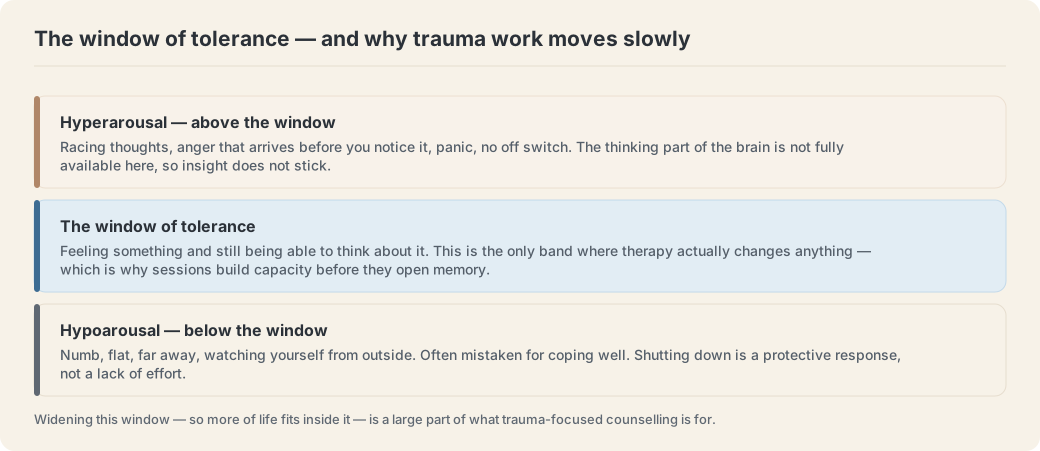
IFS sessions are more internally directed than most talking therapy. Rather than describing an event to the counsellor, you are frequently asked to turn attention inward and notice what is present. A tightness, a voice, an urge, and then to get curious about it rather than to argue with it.
Questions tend to be of the form: how do you feel toward that part? What is it worried would happen if it stopped? How long has it been doing this job? It is deliberately slow, and it can feel unusual at first, particularly for people who arrive expecting analysis.
A central concept is that beneath the parts there is a stable, non-reactive perspective the model calls Self, characterised by curiosity, calm and compassion rather than by another agenda. The work is less about a therapist fixing anything and more about establishing that perspective and letting it lead.
It also has a specific safety rule that is worth knowing: protective parts are approached first, and their permission is sought before anything more vulnerable is opened. That sequencing is what keeps the work from flooding someone, and a practitioner who skips it is not doing IFS properly.
If "part of me wants to and part of me cannot" describes your situation, a free 15-minute consultation is a place to start.
An honest word on the evidence
IFS has a large and enthusiastic clinical following, and its research base is substantially younger and smaller than that of CBT or EMDR. There is early trial evidence and growing interest, and it does not yet sit alongside the first-line trauma treatments in major clinical guidelines.
That is not a reason to dismiss it, and it is a reason to be clear-eyed. The honest position is that many clinicians and clients find it valuable, that the theory is coherent and clinically useful, and that the evidence is not yet at the level that would justify presenting it as established treatment for post-traumatic stress.
Anyone presenting IFS as a proven trauma treatment on a par with the first-line protocols is overstating what currently exists. Anyone dismissing it as unevidenced is also overstating, in the other direction.
Practically, this means that where a well-evidenced protocol exists for what you are bringing: panic, obsessive-compulsive presentations, post-traumatic stress. That protocol is usually the better opening move, with parts work available as an adjunct or an alternative if it does not fit. See CBT vs EMDR for trauma.
Who it tends to suit
- People who feel genuinely divided, The clearest indication. Where the experience is of two incompatible wants rather than one difficulty, a model built around internal multiplicity fits the experience better than one that does not.
- Anyone stuck in self-attack, Approaching a self-critical part with curiosity rather than argument frequently shifts something that direct challenging has not.
- People for whom insight has not translated, Understanding a pattern completely and continuing to enact it is a common reason people arrive at parts work.
- Those who find structured protocols alienating, IFS is exploratory rather than manualised in the way CBT is, which suits some people considerably better.
- Less suited where stabilisation is the priority, In acute crisis, or where regulation capacity is limited, building that capacity comes first, see trauma therapy.
Common questions
Does IFS mean I have multiple personalities?
No. The model describes ordinary internal multiplicity that everybody experiences. Dissociative identity disorder is a distinct clinical condition and a different matter entirely.
Is it evidence-based?
It has early trial evidence and a growing research base, considerably smaller than CBT's or EMDR's. It is not currently a first-line recommendation in major guidelines, and it would be misleading to present it as one.
Is it religious or spiritual?
The model itself is psychological. Some practitioners frame it in spiritual terms and many do not; it is a reasonable thing to ask about beforehand if it matters to you.
Can it be combined with other approaches?
Frequently, yes. Many clinicians use parts language alongside structured approaches rather than as an exclusive method.
Sources
- Canadian Mental Health Association, BC Division
- HealthLink BC, mental health and substance use
- BC Association of Clinical Counsellors
This guide is general information, not clinical advice, and it cannot diagnose anything or replace an assessment. If you are in crisis, call or text 9-8-8 (Canada, 24/7) or BC Mental Health Support at 310-6789.
Keep reading
Related pages
Where you are
Online counselling across British Columbia
Every session is by secure video, so the counsellor you see does not depend on where you live. Each city page covers coverage, local public services and who is taking new clients there.
Still deciding?
A free 15-minute consultation is the least committal way to find out whether this is a fit. No pressure, and no obligation to book a session afterward.
Book Free ConsultationNot ready to book? Send a line about what is going on. A reply comes within one business day, or read the guides first and come back when you want to.
Looking on behalf of someone else? What to send them, and what not to, including the funded routes most people do not know they qualify for.