Approach · DBT skills
DBT-informed skills, and what full DBT actually is
Full dialectical behaviour therapy is a comprehensive programme: weekly individual sessions, a weekly skills group, between-session phone coaching, and a consultation team for the therapists. Most practices offering "DBT" provide DBT-informed individual work, which uses the skills without the programme around them. That is useful and it is a different thing, and anyone who needs the full model should be told so.
A great many practices advertise DBT. Very few deliver it, and the distinction is not a technicality.
7 min read · Updated
What full DBT includes
DBT was developed for people experiencing intense, fast-moving emotion alongside self-harm and suicidality, and it has strong evidence for that population. Its effectiveness is tied to its structure, which is why the distinction matters clinically rather than only administratively.
The full model has four components running simultaneously. Weekly individual therapy with a DBT-trained clinician. A weekly skills group, typically running six months to a year, which is where the skills are actually taught. Between-session phone coaching, so skills can be applied at the moment they are needed rather than recalled a week later. And a consultation team supporting the therapists, which exists because the work is demanding.
Remove the group and you have removed where the teaching happens. Remove the coaching and you have removed the mechanism for applying skills in a crisis. What remains can be helpful and is not the treatment that was tested.
In British Columbia, full programmes are typically delivered through health authority services or specialised private programmes rather than by individual practitioners.
The four skill modules
- Distress tolerance, Getting through an acute crisis without making it worse. Concrete, immediate techniques for the moment when the urge to act is overwhelming. This is the module most often used outside full programmes and the one most immediately useful.
- Emotion regulation, Identifying emotions accurately, reducing vulnerability to intense states, and acting opposite to an emotional urge where the urge is unhelpful.
- Interpersonal effectiveness, Asking for things, declining things, and maintaining relationships and self-respect while doing so, structured to an unusual degree, which people either find clarifying or artificial.
- Mindfulness, The foundation the other three rest on. Practical rather than contemplative: noticing what is happening without immediately reacting to it.
- The dialectic itself, The idea running through all of it: that you can be doing the best you can and need to do things differently. Both at once, without either cancelling the other. For people accustomed to being told to choose, that framing is frequently the most useful part.
If you are not sure whether you need skills or the full programme, a free 15-minute consultation will give you an honest answer.
When DBT-informed work is enough
DBT-informed individual work suits someone who is not in crisis, whose difficulty is emotional intensity or interpersonal patterns rather than acute risk, and who needs specific skills rather than a comprehensive programme.
It works well for emotion regulation difficulties within an otherwise stable life, for people who have completed a full programme and want ongoing individual support, and for anyone who finds the structured skills useful without needing the surrounding scaffolding.
It also works well combined with other approaches. Distress tolerance skills in particular are used widely: in trauma work as part of stabilisation, in anxiety work, and in couples work as a way of interrupting escalation.
The honest framing is that these skills are useful to almost anybody and are not, on their own, DBT. A practice describing skills-informed individual work as DBT is at best imprecise.
When the full programme is what you need
Some situations call for the comprehensive model, and being told so plainly is more useful than a booking.
Recurrent self-harm, current or recent suicidality, and repeated crisis presentations are the clearest indications. So is a pattern of emotional dysregulation severe enough to be repeatedly destabilising relationships, work and housing. Where a borderline personality diagnosis has been made, full DBT has the strongest evidence base of any treatment for it.
In those cases, individual DBT-informed sessions are not a smaller version of the right treatment. They lack the components that make it work, and the phone coaching in particular exists precisely for the moments an individual practice cannot cover.
The route into a full programme in BC generally runs through a health authority mental health service or a specialised private programme, usually with a referral or an assessment. Psychiatry and assessment in BC covers how those routes work, and this practice will refer rather than take a booking where that is the honest answer, see standards.
If you are in crisis now: 9-8-8 by call or text, 310-6789 in BC, or 9-1-1 in immediate danger.
Common questions
Is DBT-informed therapy the same as DBT?
No. Full DBT includes a skills group, phone coaching and a therapist consultation team alongside individual sessions. DBT-informed work uses the skills without that structure, and is a different intervention.
Do I need a diagnosis to use these skills?
No. The skills are useful across a wide range of difficulties, and a Registered Clinical Counsellor does not diagnose in any case.
Where do I find a full DBT programme in BC?
Usually through a health authority mental health service or a specialised private programme. A referral or assessment is generally required, and waits vary by region.
Can DBT skills be taught by video?
The individual skills work transfers well. The group and coaching components of the full programme are a separate question and depend on the programme.
Sources
- BC government, mental health and substance use support
- Canadian Mental Health Association, BC Division
- 9-8-8 Suicide Crisis Helpline (Canada)
This guide is general information, not clinical advice, and it cannot diagnose anything or replace an assessment. If you are in crisis, call or text 9-8-8 (Canada, 24/7) or BC Mental Health Support at 310-6789.
Where you are
Online counselling across British Columbia
Every session is by secure video, so the counsellor you see does not depend on where you live. Each city page covers coverage, local public services and who is taking new clients there.
Still deciding?
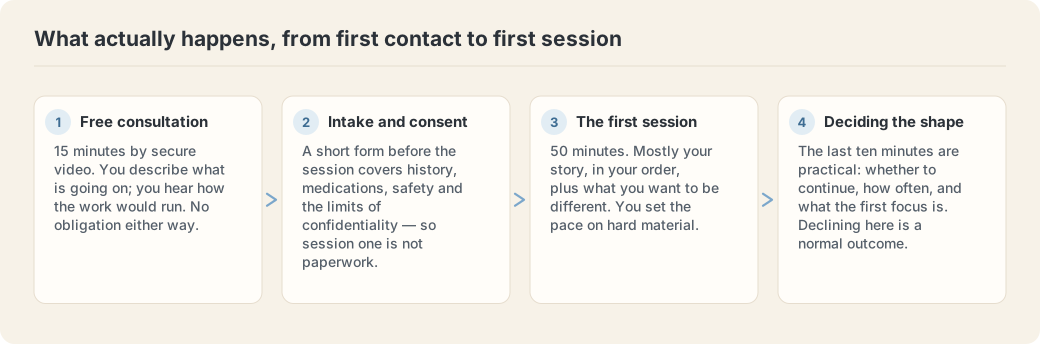
A free 15-minute consultation is the least committal way to find out whether this is a fit. No pressure, and no obligation to book a session afterward.
Book Free ConsultationNot ready to book? Send a line about what is going on. A reply comes within one business day, or read the guides first and come back when you want to.
Looking on behalf of someone else? What to send them, and what not to, including the funded routes most people do not know they qualify for.