Trauma and complex PTSD

Trauma therapist and counselling online in BC and Alberta, for trauma and complex PTSD

In short

Yes, trauma therapy can be done online. Trauma counselling online in British Columbia and Alberta is individual counselling by secure video with a Registered Clinical Counsellor: a trauma therapist, online, at a pace you set. It starts with a free 15-minute consultation, and EMDR is one option, once there is enough stability for it.

If you are looking for a trauma therapist online, Camille and Savneet take trauma clients and offer trauma counselling online in BC and Alberta, by video from wherever you are private. Complex PTSD, from things that went on for months or years, is part of that work too, and the first sessions are about safety and steadiness rather than the hardest memory.

Updated

What trauma is, in plain words

The Centre for Addiction and Mental Health describes trauma as the lasting emotional response that often follows living through a distressing event. It is the response that counts, not whether the event looks big enough from outside. A single event, years of something at home, or a job that kept putting you in front of other people’s worst days can all leave it.

When the memories do not fade, or get worse, CAMH notes that they may lead to posttraumatic stress disorder (PTSD), which usually appears within three months of the event and sometimes not for years. You do not need a diagnosis to book, and a counsellor does not need one to start.

How it tends to show up

  • Re-living itMemories, nightmares or flashes that arrive uninvited, or feeling it is happening again.
  • Steering around itAvoiding places, people, conversations or thoughts that bring it close.
  • On guardStartling easily, scanning rooms, sleep that will not hold, a short fuse.
  • Switched offNumbness, distance from people, or watching yourself from outside.
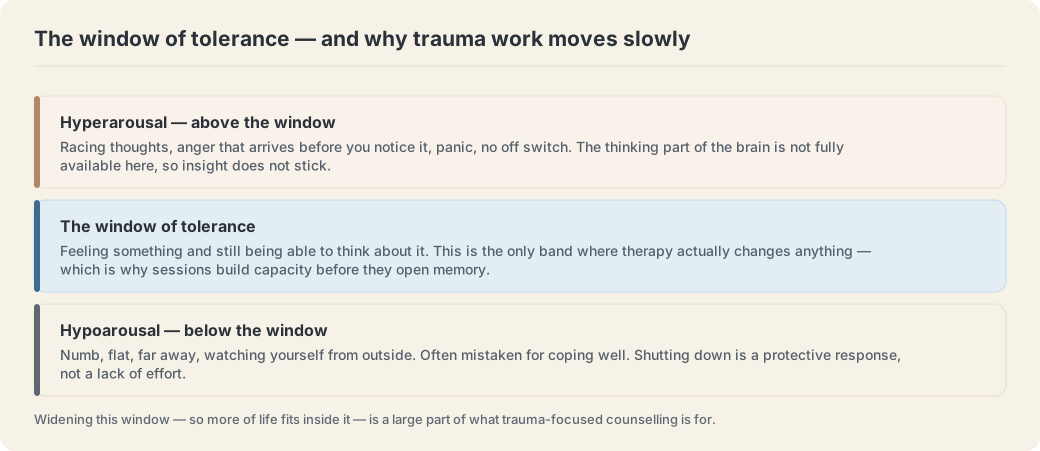
Therapy works inside the middle band, which is why capacity is built before memory is opened.

Complex PTSD: when it was not one event

CAMH separates the two simply: a single traumatic event is most likely to lead to simple PTSD, while complex PTSD tends to result from long-term, chronic trauma. The NHS lists the kinds of experience behind it, such as child abuse or neglect, ongoing domestic violence or abuse, and repeatedly witnessing violence.

Complex PTSD is a diagnosis in ICD-11, the World Health Organization’s classification; the North American DSM-5 does not include it as a separate diagnosis, which is one reason people meet the term online before they hear it in an appointment. NICE’s guideline describes it as the core symptoms of PTSD plus three more, set out below.

For complex PTSD, NICE asks clinicians to build in extra time to develop trust, with longer or more sessions as the person needs, and to take the safety and stability of their circumstances into account. That is the reason the work here starts slowly, and why nobody will ask you for the whole story in the first hour.

PTSD and complex PTSD side by side, as NICE NG116 and the NHS describe them
PTSDComplex PTSD
What usually comes before itOne or more traumatic eventsProlonged or repeated trauma that was hard or impossible to escape
Re-living, avoiding, being on guardYes, these are the coreYes, all of the core symptoms of PTSD
Feelings that are very hard to steady, or switch offCan happenSevere and pervasive: part of the diagnosis
Seeing yourself as worthless, with shame or guiltCan happenPersistent: part of the diagnosis
Staying close to people, trusting anyoneCan be strainedPersistent difficulty: part of the diagnosis

Trauma counselling online in BC and Alberta: how each counsellor works

Each counsellor comes at trauma from her own training, and each starts in the same place: enough safety and control first, so that whatever comes next is your choice. These are the methods each one lists for herself; nothing here is something she does not.

Camille Granda, Registered Clinical Counsellor, seated and listening

Taking new clients

Camille Granda, RCC, CCC

English and Tagalog · BC and Alberta

  • Trauma-informed pacingYou can always say no, slow down or change direction; the work stays inside what your nervous system can manage.
  • EMDRFor memories that still drive how you react. Safety, resources and trust come first, and you do not have to tell every detail.
  • Somatic trauma therapyAttention to what the body does when something comes close, alongside the thoughts and feelings.
  • Polyvagal-informed workA way of noticing when the nervous system shifts into threat or shutdown, and of bringing it back within reach.
Savneet Singh, counsellor at Westpeak Wellness, smiling at the camera

Taking new clients

Savneet Singh, RCC

English and Punjabi · BC and Alberta

  • DBT skillsHandling difficult emotions without feeling controlled by them, when trauma has made them hard to steady.
  • CBTHow thoughts, feelings and behaviour connect, for the beliefs about yourself that the trauma left behind.
  • ACTMaking room for what cannot be undone, while moving towards what matters to you now.

Individual sessions are $140 for 50 minutes. EMDR is offered as a 90-minute intensive at $190, or within 50-minute sessions at $140. The intensive is a later option, once there is enough stability for it. Fees and receipts are on the pricing page.

Each counsellor is a Registered Clinical Counsellor, and the registration can be checked on the BCACC register in about two minutes.

Many extended health plans reimburse a Registered Clinical Counsellor, depending on the plan, so check yours; MSP does not. Receipts are issued for every session, and the fees are published in full. On a calendar-year plan, sessions held by 31 December count against this year: using benefits before the plan year ends.

The first weeks with a trauma therapist online

  1. A free consultationAbout fit, not history: what you want help with, and whether this is the right place for it.
  2. Safety and steadinessGrounding, sleep, what sets things off, and what already helps. Nothing about the worst of it yet.
  3. Processing, at your paceOnly when you are ready, and only what you choose: talking, body-based work, or EMDR with Camille.
  4. Carrying it forwardWhat changes in how you live with it, and what to do when an anniversary or a reminder comes round.

When this is not the right fit

  • You are not safe right now If the harm is still happening, safety comes before therapy. The crisis lines below can help you plan it.
  • You need a diagnosis or medication Counsellors do not diagnose or prescribe. Your family doctor or a nurse practitioner does, and counselling can run alongside.
  • You need more than a weekly hour If daily life has stopped holding, a programme with a team behind it is the safer first step; your doctor can refer you.

Questions people ask about online trauma therapy

Can trauma therapy be done online?

Yes. The session is the same hour with the same counsellor, by secure video from a room where you are private. You are never required to be on camera. If online is not right for you, the consultation is the place to say so.

Is there a trauma therapist near me, or is it all online?

All online: there is no office, so near you means anywhere in British Columbia and Alberta with a room where you are private, and the session is the same hour wherever you sit. If you would rather be in a room with someone, your family doctor or free and low-cost counselling in BC can point to a local service. If the trauma came from work, an accepted WorkSafeBC claim pays for treatment; after a crash in BC, ICBC funds counselling.

What is the difference between PTSD and complex PTSD?

PTSD can follow one event. Complex PTSD usually follows trauma that went on, often in childhood or in a relationship, and adds three things to the core symptoms: emotions that are very hard to steady, a lasting sense of being worthless or ashamed, and difficulty staying close to people. The table above sets them side by side, from NICE’s guideline.

Do I have to talk about what happened?

No, not to start and not in full. Camille’s own words on her profile: you do not have to tell her every detail of what happened for the two of you to work with how it is affecting you now. Savneet works with trauma at whatever pace feels right, sometimes before you are ready to look at it at all.

Is EMDR the same as trauma therapy?

EMDR is one method within it. Camille is trained in EMDR and offers it inside weekly sessions or as a longer intensive; the EMDR page explains both, and CBT vs EMDR for trauma compares the two.

How much does trauma therapy cost?

An individual session is $140 for 50 minutes, after a free 15-minute consultation.Many extended health plans reimburse a Registered Clinical Counsellor, depending on the plan, so check yours. The pricing page has the receipt details.

Do you see clients in Alberta?

Camille and Savneet see clients in British Columbia and Alberta by video, and the fee and the booking are the same wherever you are.

Keep reading

Sources

General information, not clinical advice and not a diagnosis. Counsellors at this practice do not diagnose or prescribe.

Talk it through with a counsellor first.

A free 15-minute consultation over secure video, about what you want help with and whether this is the right fit.

Book Free Consultation

Not ready to book? Send a line about what is going on. A reply comes within one business day, or read the guides first and come back when you want to.

Looking on behalf of someone else? What to send them, and what not to.