the city proper, not the suburbs · Online · ਪੰਜਾਬੀ
Punjabi-speaking counselling in Vancouver
Punjabi-speaking counselling for Vancouver is with Savneet Singh, RCC, by secure video, in English or Punjabi, or a mix of both. Individual sessions are $140 for 50 minutes, after a free 15-minute consultation, and whether an extended health plan reimburses it depends on the plan.
Updated
Punjabi is the fifth mother tongue in Vancouver, behind Cantonese and Mandarin. Being multilingual as a city is not the same as being multilingual in your language.
Who you would be working with
Savneet Singh, RCC: Registered Clinical Counsellor, working in Punjabi and English by secure video. She works with anxiety, depression, trauma and attachment, personality disorders. Her registration number is on her profile, and you can check her registration with BCACC before booking from Vancouver.
There is also a page for Savneet and Vancouver, and the same page ਪੰਜਾਬੀ ਵਿੱਚ.
Dispersed, not concentrated, and that changes what is available
Vancouver residents, just 2.0%, Punjabi is only the fifth mother tongue here, behind Cantonese and Mandarin
City of Vancouver, 2021 Census: Indigenous Peoples and Language
In the 2021 census Punjabi was the mother tongue of 13,305 people in the City of Vancouver, about 2.0% of the population. It ranked fifth, behind English at 50.7%, Cantonese at 11.8%, Mandarin at 6.4% and Tagalog at 2.9%.
Vancouver is one of the most linguistically diverse cities in the country, at least 190 languages are spoken here. That is exactly why this page exists: a city being multilingual is not the same as it being multilingual in your language.
The provincial picture inverts the city one. British Columbia has roughly 315,000 Punjabi speakers, and Surrey alone has 128,305. The community, its institutions and nearly all its Punjabi-speaking clinicians are across the river.
There is no Punjabi neighbourhood in Vancouver proper in the way there is in Surrey or Abbotsford. The 13,305 people are spread across the city rather than gathered in it, which has a specific and under-discussed consequence: the services that grow around a concentrated community do not grow around a dispersed one.
When a Vancouver organisation advertises counselling "in your language", the languages in question are usually Cantonese and Mandarin. That is not a failure on anyone's part. It follows the numbers, and those services are good. It does mean that a Punjabi speaker in Vancouver is a minority inside the multilingual majority, and routinely finds that the multilingual option on offer is not theirs.
The practical answer for years has been to go to Surrey. That works, and for some people it is the right call. It also means a bridge or a tunnel, transit at rush hour, and an appointment that costs most of an evening, which is the same arithmetic that quietly ends courses of therapy everywhere, applied to language access specifically.
Vancouver Coastal Health runs free mental-health services and they are worth knowing about before paying for anything. What they do not reliably provide is a counsellor who works in Punjabi.
There is a second thing specific to this city, and it is not about language at all. Vancouver has a well-documented reputation as a hard place to make friends, particularly for people who arrived as adults. For somebody carrying both that isolation and a family context nobody around them recognises, the loneliness is doubled rather than added.
The cost side of counselling in this city, and it is the real constraint here rather than supply, is covered on online counselling for Vancouver.
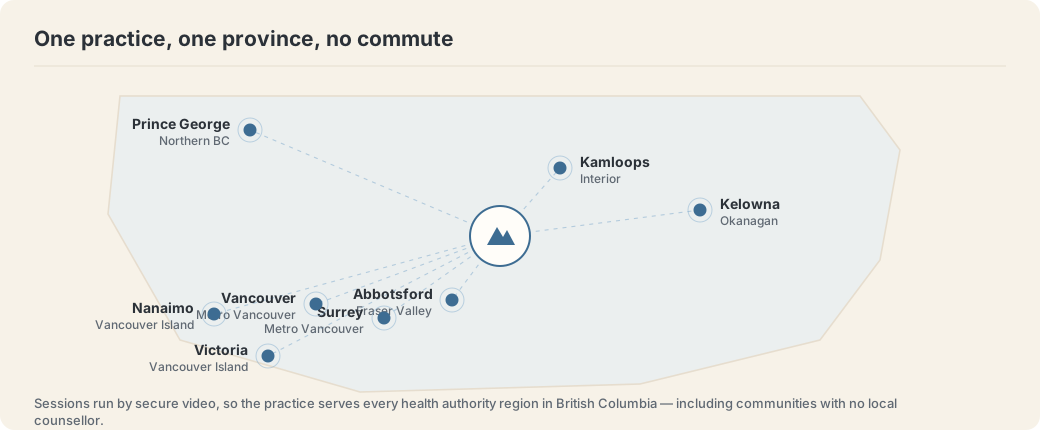
Why virtual, specifically here
What changes when language stops being the barrier
No trip to Surrey
The most common practical reason people here choose virtual. A bridge, transit at rush hour, and most of an evening is what a Punjabi-language appointment has historically cost from Vancouver.
Punjabi, English, or both
Sessions move between the two as needed. Clinical and administrative terms usually stay in English, because those are the words people actually use.
Cultural context without the preamble
Family expectations, generational silence and "log kya kahenge" do not need explaining from first principles before the work can start.
Lunch-break appointments
A session from a closed office or a parked car is entirely workable, and removes the need to explain an absence, which matters if you live with family.
Outside the community network
No overlapping family circles, and no chance of meeting your counsellor at a wedding. Confidentiality is a legal duty everywhere; distance is what makes it feel true.
Not sure whether this is the right fit? A free 15-minute consultation is the fastest way to find out, and it is a perfectly good outcome if the answer turns out to be a referral somewhere else.
Questions from Vancouver
Before you book
Why not just see somebody in Surrey?
You can, and for some people that is the right answer. The choice is wider there and you would be told so on a consultation call. What Surrey costs from Vancouver is the travel: a bridge or tunnel, rush-hour transit, and an appointment that takes most of an evening rather than fifty minutes. That cost is the single most common reason weekly therapy quietly stops.
How do I find a Punjabi-speaking counsellor or therapist in Vancouver itself?
Nobody publishes a count by city, and availability and openings vary. BCACC’s Find a Counsellor directory filters by language, which is the quickest way to see who is listed. For context, Punjabi is the fifth mother tongue here at 2.0%; Cantonese and Mandarin are several times larger. Therapist and counsellor describe the same work here; this practice’s Punjabi-speaking counsellor is a Registered Clinical Counsellor who sees Vancouver clients by secure video.
Can the whole session be in Punjabi?
Yes. Sessions run in Punjabi, in English, or moving between the two, whichever the moment calls for. Most people switch without planning to, usually into Punjabi when the subject is family and back into English for practical planning, and that switch is worth paying attention to rather than correcting.
Is there a free option I should try first?
Vancouver Coastal Health runs free mental-health services and there is a broader set of free and low-cost options across BC worth checking before paying out of pocket. They are delivered in English. If language is the barrier you are trying to solve, that is where this practice is different.
I live with family and have no private space. What do people do?
This is one of the most common practical questions, and there are workable answers, a parked car, a session scheduled during a work break from the office, headphones and a closed door. It is worth raising on the consultation call so it is solved before the first session rather than during it.
Will my extended health cover this?
Plans that list an RCC usually reimburse a video session on the same terms as in person, but this depends on the plan. Ask: are virtual sessions with an RCC eligible, and on the same maximum?
More in the full list of frequently asked questions, or see fees and extended-health coverage. There is also a full page in Punjabi (ਪੰਜਾਬੀ), and Vancouver has its own card, in Punjabi, in the Punjabi-language index of regions.
Counselling in Punjabi, from Vancouver
A free 15-minute consultation over secure video, in Punjabi or English. No pressure, no commitment, and no obligation to book a session afterward.
Book Free ConsultationNot ready to book? Send a line about what is going on. A reply comes within one business day, or read the guides first and come back when you want to.
Looking on behalf of someone else? What to send them, and what not to, including the funded routes most people do not know they qualify for.