Resource · For employers
Counselling support for BC teams: what employers can actually offer
Somebody on your team is struggling right now — statistically, several somebodies. Most employers genuinely want to help and have been sold exactly one tool. This page is the fuller toolbox.
6 min read · Reviewed August 28, 2026
For a BC employer, real mental-health support is mostly plumbing, not posters: an extended-health plan whose wording actually covers Registered Clinical Counsellors at a meaningful annual maximum; an EAP understood honestly as triage rather than treatment; sick days and leave handled the way the Employment Standards Act and Human Rights Code require, without diagnosis-fishing; and managers who can say "you seem underwater — what do you need?" without practising medicine. A practice like this one fits at the referral end: somewhere concrete to point a struggling employee, bookable that week, in English or Punjabi.
The plumbing that actually moves the needle
- Check your plan’s counselling wording — The single highest-leverage employer action costs a phone call: confirm the extended-health plan reimburses "Registered Clinical Counsellors" (not only psychologists), and look hard at the annual maximum — a $300 cap funds two sessions and is a gesture, not a benefit. Raising the paramedical maximum is often surprisingly cheap at renewal.
- Know what your EAP is for — Employee-assistance programs are genuinely useful triage: fast, free, confidential first conversations. They are also capped at a handful of sessions and staffed for generalist short-term work. Presenting the EAP as "we provide counselling" oversells it; presenting it as "a free first step, with real coverage behind it" is honest and works. The EAP comparison on this site is written for employees; it reads just as well for the people buying the program.
- Handle leave lawfully and gracefully — The ESA sick days apply to mental health without qualification; medical notes need functional information, never diagnosis; and the Human Rights Code’s duty to accommodate covers psychological disability. The work-and-money cluster on this site maps the whole terrain — sending a struggling employee a link costs nothing and signals everything.
- Train the sentence, not the diagnosis — Managers do not need mental-health-first-aid certification to say: "You seem like you are carrying a lot. What would help?" The skill is noticing plus asking plus not prescribing. Everything after that sentence belongs to professionals and to the employee’s own choices.
The useful employer move costs a bookmark: know where you would point someone before the Tuesday you need to. See how the consultation works.
Where a practice like this one fits
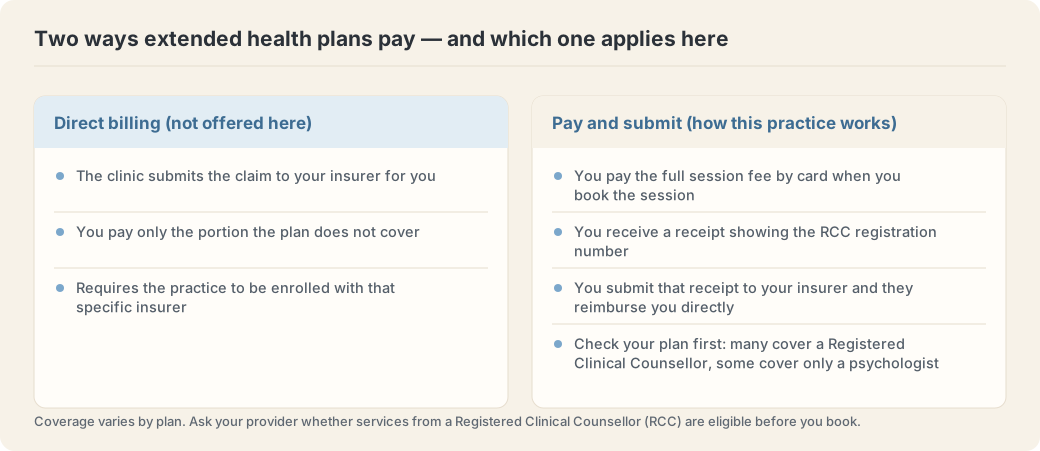
Not as your EAP — this is a solo Registered Clinical Counsellor practice, and pretending otherwise would be the kind of overclaim this site is allergic to. Where it fits is the referral end of your toolbox: a concrete answer to "where would someone actually go?" — online across all of BC, evening availability that hourly and shift staff can use, sessions in English or Punjabi, fees published, receipts that work with every plan that covers RCCs, and a free 15-minute consultation an employee can book without telling anyone at work.
For Fraser Valley and Surrey employers specifically, the Punjabi-language capability may be the most useful line on this page: a meaningful share of the region’s workforce carries its hardest conversations in Punjabi, and English-only support quietly excludes them. Pointing to a bilingual option is a concrete act of inclusion that costs a bookmark.
What this page deliberately does not offer: workshops, lunch-and-learns, or wellness-week content. Those have their place; they are also the tool most often used instead of the plumbing above, and the plumbing is what your people will actually feel.
Common questions
Can we pay for an employee’s counselling directly?
The cleaner routes are the ones already built for it: a healthy paramedical maximum on your plan, or a health-spending account the employee draws on privately. Direct employer payment creates confidentiality tangles nobody wants — the employee’s counselling should never be visible to the employer, including in gratitude.
Will we be told if an employee books here?
No, categorically. Counselling is confidential from employers regardless of who suggested it, what benefits reimburse it, or how supportive the intent. What you get instead is the thing you actually wanted: a team member getting help.
What should a manager do in the moment with a struggling employee?
Ask, listen, and point — "what would help?", genuine attention, and knowledge of the concrete options: the EAP for today, the benefits plan for treatment, the sick days without interrogation, and a real practice’s booking page. Managers go wrong by diagnosing or by fixing; the job is noticing and routing.
Is an EAP enough on its own?
As triage, yes; as treatment, usually not — session caps mean anything beyond a rough patch needs a handoff to ongoing care, which is where plan coverage of RCCs becomes the load-bearing benefit. The honest employer framing: "free first conversations through the EAP, real coverage for ongoing counselling through the plan."
Do you run workplace workshops?
No — this practice does one thing, which is counselling. For workplace education, CMHA BC offers established programs. What this practice offers your team is a concrete, bookable place to send someone, which in practice is the piece most toolboxes are missing.
Sources
- Province of BC — employment standards: leaves and sick days
- BC Office of the Human Rights Commissioner
- Canadian Mental Health Association, BC Division — workplace programs
General information, not clinical, financial, or legal advice. Coverage and service details change — verify anything decision-critical directly with the provider or insurer. If you are in crisis, call or text 9-8-8 (Canada, 24/7) or 310-6789 for BC Mental Health Support.
Questions about cost or coverage?
A free 15-minute consultation is a good place to ask them, before committing to anything.
Book Free ConsultationLooking on behalf of someone else? What to send them, and what not to — including the funded routes most people do not know they qualify for.