Loading available times…
Free · 30 minutes · No commitment
Book a free couples consultation with Camille.
A short conversation over secure video to work out whether this is a fit. Nothing is diagnosed, and there is no obligation to book a session afterwards. Camille speaks English and Tagalog.
- 30 minutes
- Online only · secure video
- No card
- No intake form
- No charge to move or cancel it
- Who you talk to. Camille directly — the counsellor you would see, not an intake worker. Registered Clinical Counsellor means a master’s degree in counselling, supervised clinical hours, a code of ethics and a complaints process through the BCACC, which you can check yourself.
- What is asked. What brought the two of you here, in your own words. No form, and no history to assemble.
- What it costs. Nothing is charged and no card is taken. You decide afterwards, in your own time. Sessions after it: couples $175 (50 minutes), couples extended $340 (110 minutes), card taken at booking. Whether your plan reimburses a Registered Clinical Counsellor depends on the plan.

Booking with Camille Granda, RCC, CCC · English and Tagalog
Camille Granda, RCC, CCC · Registered Clinical Counsellor (verify on the BCACC register (opens in a new tab)) · Canadian Certified Counsellor (verify on the CCPA directory (opens in a new tab)) · works in English and Tagalog
Free 30-minute consultation
You are booking a couples consultation with Camille Granda, RCC, CCC
Every session, this one included, is by secure video from wherever you are. There is nowhere to attend, whatever address the booking summary shows.
For the two of you: one of you picks the time, and both partners can join the free 30-minute consultation.
Pick a time with Camille
Open Camille’s calendar in a new tab
The calendar opens here. If it does not load on your phone, the link above always will.
Calendar hard to use with your screen reader or device? Ask for a consultation time by email (info@westpeakwellness.com) instead, or use the form below.
Calendar not loading? Open the booking page directly, in a new tab.
Times on this page are Pacific time (Alberta and most of the East Kootenay are one hour ahead today).
None of these times work?
Say when you are usually free and Camille will reply within one business day with the closest time she can offer.
Sessions with Camille are for people located anywhere in Canada. A session counts as happening where you are sitting, so this is a registration and insurance boundary rather than a preference.
The consultation can be in English or Tagalog, including moving between them, which is what most bilingual people end up doing.
After you book, a confirmation email arrives with the video link. Nothing to install, and a phone, tablet or computer works. You are never required to be on camera to be in a session. No diagnosis, referral or decision on the spot is needed. More on the call itself.
Before you decide
Is this online or in person?
Online. The consultation and every session are by secure video, from wherever you are sitting. There is no office and nowhere to attend; any address on a booking confirmation is the booking system’s mailing record, not a place to go.
What actually happens in the 30 minutes?
You say what brought you here, in your own words. There is no form and no history to assemble. “Something is off and I do not know what” is an ordinary opening, and a large share of consultations start close to it.
You hear how the work would go: the approach that fits what you have described, roughly how long that tends to take, and what it costs. Then you decide, in your own time. Nobody is asked to commit on the call.
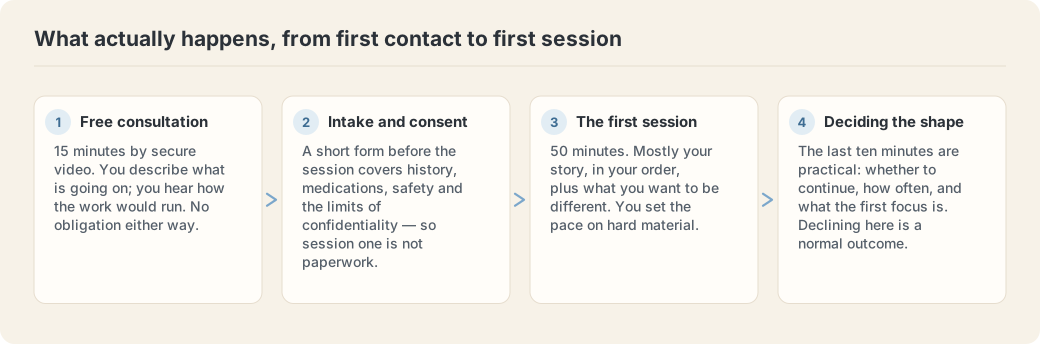
What do the first few sessions look like if I carry on?
Session one is the whole picture: what is going on, how long it has been going on, and what you want to be different. Before the first paid session you sign the practice’s consent form, which puts the limits of confidentiality and the 24-hour cancellation rule in writing. Session one then covers what brought you, some history, current concerns and safety, and you can decline to go into anything.
Sessions two and three look for the pattern underneath the episodes rather than working through them one at a time.
Around session four there is a deliberate check on whether this is working, asked out loud rather than left to you to raise.
After that it is your call, every time. How long therapy takes covers the commitment honestly, and when therapy is not working covers what to do if it is not.
Is there anything I should prepare?
No. You are also not expected to tell the whole story: thirty minutes is not enough for that and it is not what the call is for. If it helps to arrive with anything, one sentence on what is going on and one on how long it has been going on is more than sufficient.
How does the video work, and where is my information held?
The link arrives by email and opens in your browser: nothing to install, no account to create, and sessions are never recorded. You are never required to be on camera to be in a session. Bookings and records are held in Cliniko, in an account on its Canadian region. The privacy page names every service involved.
Will my employer, insurer or family find out?
Nothing goes to your employer, your family, your doctor or your insurer without your written consent. A receipt you claim with shows that a session took place, the fee and the counsellor’s RCC designation, not what was said; an RCC does not diagnose, so there is no diagnosis on it either. Receipts and booking emails go only to the email address you give, so a personal address keeps them out of a work inbox. Session notes are brief working notes, not transcripts, held in Cliniko’s Canadian region, and sessions are never recorded. What an insurer reports to the employer that sponsors the plan is set by the plan, not by this practice, so if that matters to you, ask the plan. Confidentiality has legal limits, which are risk of serious harm to you or someone else, a child or vulnerable adult at risk of abuse or neglect, or a court order.
What should I ask on the call?
The consultation goes both ways, and the more useful version has you asking rather than only answering. What approach would you use for this and why. How would we know it was working. What do you not work with. What does it cost and is that the whole cost. Questions worth asking a therapist sets out the full list along with the answers that should make you wary. Every one of them is fair game here.
What if it turns out not to be a fit?
A consultation that ends with “this is not the right fit” is a success, not a failure. Sometimes that means a different counsellor; sometimes a physician, a psychologist for a formal assessment, or a specialised service. The limits of what this practice does are listed openly on standards and accountability, and being told one of them applies to you is a better result than a booking that was never going to help.
If cost is the obstacle, low-cost counselling in BC lists the free and reduced-cost routes, several of which have no waitlist at all.
- Sessions are fully online, anywhere in anywhere in Canada
- Available in English or Tagalog
- Couples sessions are 50 or 110 minutes
- Fees and payment are on the fees page
- Many extended health plans reimburse an RCC, depending on the plan; check yours
Would rather read first? The FAQ covers fees and confidentiality, services covers the approaches, and about Camille covers who you would be speaking to. To ask something before booking anything, the contact page gets a reply within one business day.